
CIA Director Meets With Cuban Officials as U.S. Pressure Mounts
On May 14, Cuba’s government announced that at the request of the US, the Director of the U.S. Central Intelligence Agency (CIA), John Ratcliffe, had arrived in Havana for meetings with senior Cuban officials. The purpose of the visit was to “personally deliver President Trump’s message that the United States is prepared to seriously engage on economic and security issues, but only if Cuba makes fundamental changes,” per a statement made by the CIA to press. According to reports, discussions focused on security issues, economic conditions, and intelligence cooperation. One unnamed CIA official said the Director met with the grandson of former President Raúl Castro, Raúl Rodríguez Castro, the Minister of the Interior, Lázaro Alvarez Casas, and a senior Cuban intelligence official.
This was the first public trip to Cuba by a CIA Director, although the Washington Post notes that Director John Brennan made a secret trip in 2015. The visit comes amid reporting that President Trump’s team is frustrated by the slow pace of negotiations with Havana, even as the administration continues to shape the terms of engagement. Secretary of State Marco Rubio has continued to emphasize the importance of political transition in Cuba stating: “I don’t think we’re going to be able to change the trajectory of Cuba as long as these people are in charge of that regime.”
President Trump has continued to escalate his rhetoric toward Cuba, signaling dissatisfaction with what the administration views as a lack of cooperation from Cuba’s government and suggesting that Havana is not taking U.S. threats seriously.
At the same time, there are signs that discussions between the two governments may be progressing behind the scenes. Havana appears to be willing to consider a reported $100 million U.S. humanitarian assistance package, potentially to be distributed through the Catholic Church and other humanitarian organizations, while Washington has floated expanded satellite internet access through Starlink. Cuba has so far remained notably cautious and largely silent regarding the Starlink component. Questions also remain about implementation capacity, as a $6 million U.S. aid package routed through Church structures and announced in February has yet to be distributed, amid fuel shortages, transportation constraints, and the difficulties of operating outside state-linked systems in Cuba’s highly centralized economy.
Cuba’s apparent willingness to engage in humanitarian assistance may signal a notable shift in the broader dynamic between Washington and Havana. Cuba’s Ambassador to the U.S., Lianys Torres Rivera, told The Hill in an interview that details about the aid package, including whether it would consist of cash or material aid, remain unclear. Secretary Rubio has stated that the only condition for the aid is that it be distributed by non-governmental sources, though it’s hard to imagine a scenario in which the US would not demand any concessions from Havana. However, Director Ratcliffe’s visit appears to have coincided with at least one concession from Havana. According to a video from the Cuban Observatory of Human Rights, Sissi Abascal Zamora, a July 11 protester and member of the Ladies in White movement, was released from prison on May 14 and is now exiled with her family in Miami.
Taken together, these developments suggest that the exploratory engagement between both governments will continue. While it remains unclear whether they amount to the early stages of a broader understanding, they point to a more complex and fluid dynamic than public rhetoric alone suggests.
Pressure from Washington continues to intensify. New reporting indicates that the US is preparing an indictment against Raúl Castro for the government’s 1996 shootdown of two Brothers to the Rescue planes. The Miami Herald reported that this indictment is expected to be unsealed on May 20, Cuba’s day of independence. The move mirrors the strategy previously used against Venezuela’s Nicolás Maduro before his capture and indictment earlier this year. Although Raúl Castro no longer formally leads Cuba’s government, he is still widely regarded as the island’s most influential political figure.
The visit from Director Ratcliffe also comes just weeks after the Trump administration released a May 1 executive order and new Office of Foreign Assets Control (OFAC) guidance that significantly expand sanctions on Cuba’s economy and bring secondary sanctions on entities that engage with designated actors.
To better understand the implications of the executive order, CEDA spoke with Dr. William LeoGrande, Professor of Government at American University and a leading expert on U.S.-Cuba relations. Dr. LeoGrande noted that while most existing sanctions target “U.S. persons,” the new executive order expands the risk to foreign companies and financial institutions engaging with Cuba. He warned that foreign firms may increasingly face a choice between doing business in Cuba or in the US.
According to Dr. LeoGrande, the broader impact could be “far-reaching and devastating,” particularly because the threat of sanctions may deepen existing “over-compliance,” where banks, shipping companies, and businesses avoid even legally permitted transactions out of fear of violating U.S. regulations. You can read the full explainer here.
The executive order also prompted a wave of responses from Cuban officials, who condemned the new measures. Cuba’s Ministry of Foreign Affairs (MINREX) rejected the order, calling it “criminal” and accusing Washington of attempting to create “a social, economic and political catastrophe at a national scale.”
Meanwhile, reporting has found that the US is ramping up its intelligence-gathering flights around the island, having conducted at least 25 flights using manned aircraft and drones since February 4. This has raised alarms for many, as similar surges in surveillance flights occurred before U.S. operations in Iran and Venezuela, though others caution the flights may be an attempt to urge Cuba to make a deal.
Still, signals from Washington remain mixed. On May 7, the Associated Press reported, citing unnamed administration officials, that the US is not currently pursuing “imminent military action” against Cuba. That same day, during a meeting with Brazil's President Luiz Inácio Lula da Silva, President Trump reportedly suggested that military intervention was not currently planned.
The pressure campaign comes as Cuba’s Minister of Energy, Vicente de la O Levy, recently acknowledged that the island has effectively run out of fuel due to a roughly four month U.S. oil blockade and warned that blackouts could soon exceed 20 to 22 hours per day. On May 14, a major power outage swept across eastern Cuba, cutting electricity from Guantánamo to Ciego de Ávila.
American public opinion in the US appears skeptical of military escalation. A new YouGov poll found that 64 percent of Americans oppose the US going to war against Cuba. Meanwhile, parts of the South Florida Cuban-American community continue pressing for stronger action. Representative María Elvira Salazar (FL-27) wrote on her personal X account, “Cubans on the island are waiting. Cubans in Miami are waiting. We are waiting for you to give the order. And it will be done.”
Other Republican lawmakers have explicitly stated they are not in support of military action in Cuba. Senate Majority Leader John Thune said the focus should remain on reopening the Strait of Hormuz. Several Republican senators also verbally expressed opposition to military action, including Senators James Lankford (OK), Susan Collins (ME), and Rand Paul (KY).
Despite repeated statements from U.S. officials, including President Trump himself, denying plans for military action, the administration has clearly signaled that it intends to pursue major change on the island. Whether current pressure ultimately produces a negotiated economic arrangement, deeper political concessions from Havana, or a more dangerous escalation remains unclear.
Havana Dispatch #5 by Natalia Favre
We continue to spotlight the writing of Natalia Favre, a photographer based in Havana. Below is her fifth and final dispatch from Havana, written for the U.S.-Cuba News Brief. You can find the original version in Spanish here.
“The sensation is similar to that of the pandemic. When the sun began to dip after a full day cooped up inside the house, I would run down the hill to catch a glimpse of the horizon before my head exploded. We didn’t have much time. Quarantine began at eight o’clock, and, like me, hundreds would flock to the Malecón to breathe in the salty breeze and release the heat our bodies had absorbed within four walls. Today, more than five years later and with no COVID circulating, the collective anxiety bears a striking resemblance to that of those days.
It is nothing new for the Malecón to be known as “Havana’s great sofa”; yet, when there isn’t enough electricity to even power the fans that circulate the humid, warm air, it transforms into both a refuge and an escape. Along the stretch of more than seven kilometers running from Vedado to Old Havana, passing through Centro Habana, or vice versa, I encounter scenes of every kind.
Sundays are the noisiest days. At the intersection of Prado and the Malecón, a tambor is held in honor of Yemayá. Down the steps that lead directly to the diente de perro, the collection of sharp rocks along the Havana coast, percussionists beat their drums while a crowd sings in Yoruba. Surrounding the celebration, families bathe in the sea, and a group of young people chat while sharing a bottle of rum.
Upon reaching Centro Habana, a father, or perhaps a grandfather, lies stretched out on the seawall, gazing at the sky with a lost look in his eyes; only Yemayá knows what he is thinking. Barefoot, and leaning against his shoulder, sits his son or perhaps his grandson; I cannot say for sure, as I wished to not interrupt them.
In La Isla en peso, the poem Virgilio Piñera wrote in 1943, which feels as though it could’ve been written today, "the accursed circumstance of water on all sides" represents both the tragedy inherent in this island’s geographical condition and the sense of confinement that living here sometimes entails. The sea, hidden behind the concrete wall, or furiously flooding everything in its path, is both the boundary and the abyss.
May has begun, and the news warns that the first heatwave is approaching. The blackouts offer no respite, and the crisis has left people with empty pockets. I ask myself: What would become of the Habaneros without the Malecón?”
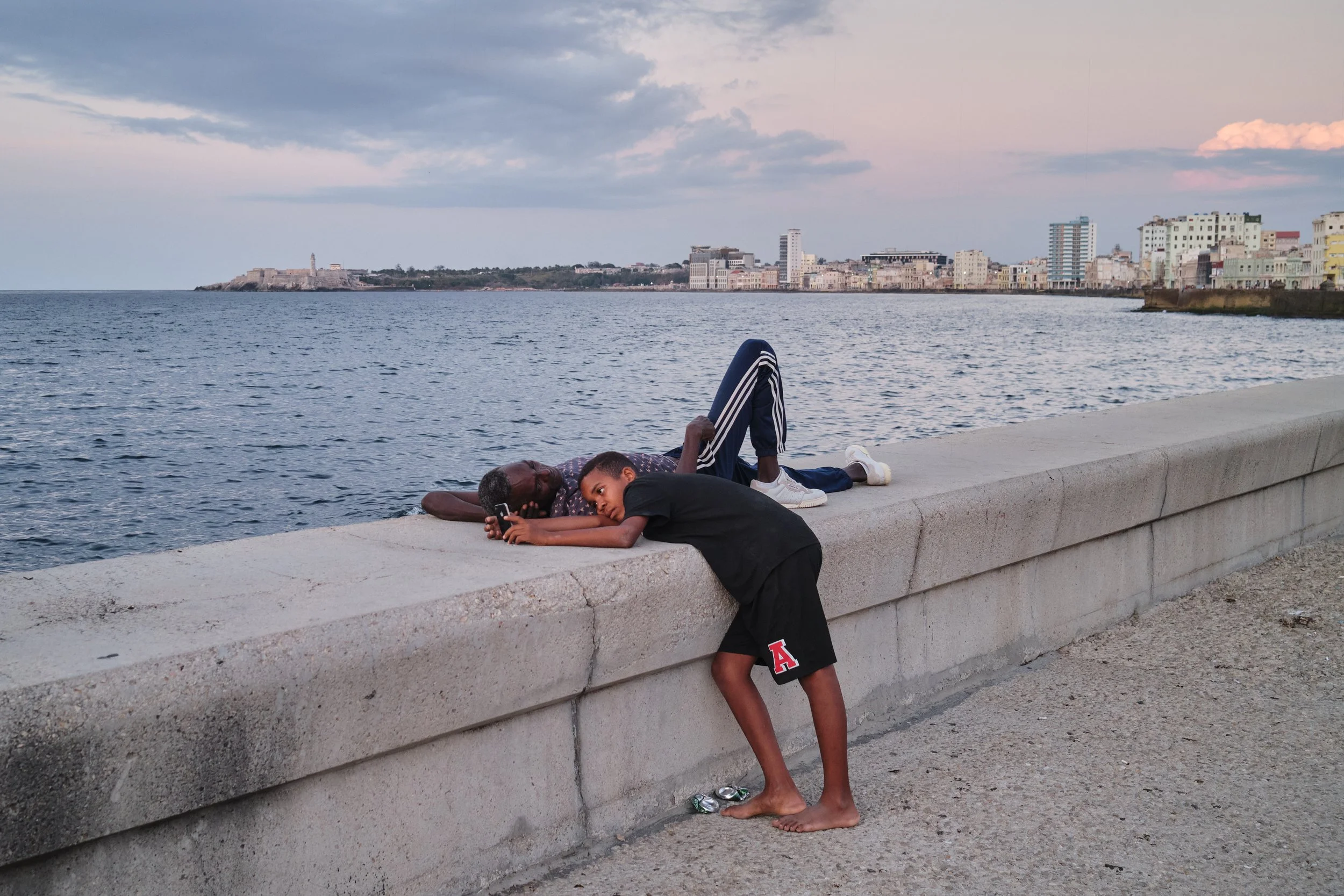
Photo Credit: Natalia Favre
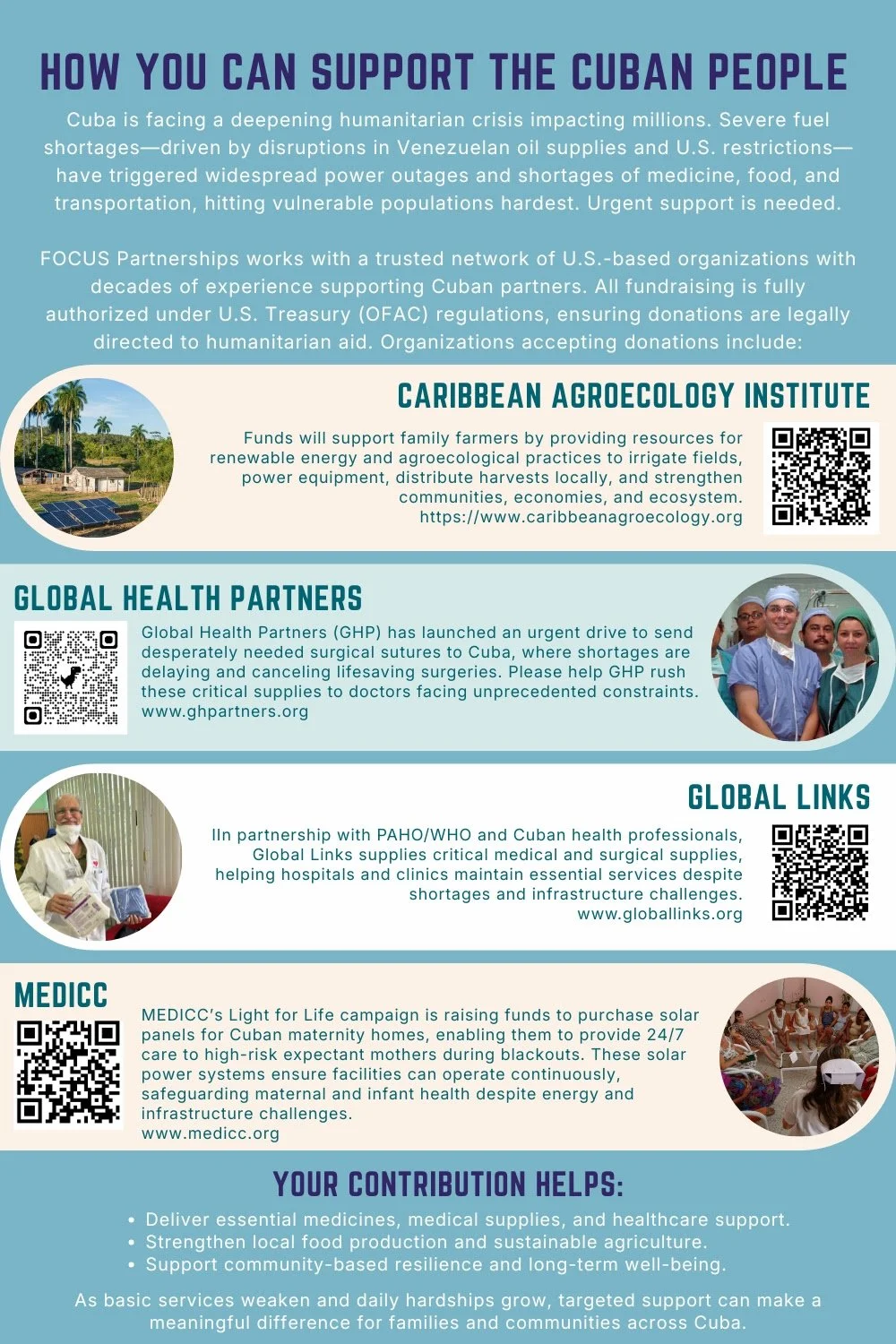
To support the Cuban people as daily life gets more challenging, please consider supporting the following organizations. This list has been curated by FOCUS, an initiative to strengthen collaboration between communities in Cuba and the US.
U.S.-CUBA NEWS
Cuba Offered $100 Million in Humanitarian Aid from US
During Secretary of State Marco Rubio’s recent trip to the Vatican, he told reporters that the US had offered Cuba $100 million in humanitarian aid to be distributed through the Catholic Church, but Cuba’s government had rejected the assistance. The offer had not previously been made public, but was later formally acknowledged by the State Department. In its statement, the State Department also claimed it had made “numerous private offers to the Cuban regime” to support the Cuban people, including assistance for free satellite internet for two years through Elon Musk’s Starlink.
On May 14, Cuba’s President Miguel Díaz-Canel signaled that Havana would be open to receiving the proposed humanitarian aid if it were delivered in accordance with internationally recognized humanitarian principles. Cuba’s Foreign Minister Bruno Rodríguez Parrilla responded on X, stating “the Cuban government does not have a practice of rejecting foreign aid,” and that Cuba was, “willing to hear the details of the offer and the manner in which it would be implemented.” His statement did not directly deny Secretary Rubio’s claim that the offer had initially been rejected.
Since President Trump returned to office, the State Department has committed $3 million in hurricane relief aid following Hurricane Melissa in late October. Caritas Cuba began distributing that aid on January 14. Per their latest statement, only 82 percent of the funds have been distributed, with the remaining 18 percent expected to be delivered before the end of May. A second round of aid totaling $6 million, announced by the U.S. government in February, has yet to be distributed. Caritas has said it will begin delivering those funds once the initial $3 million distribution is completed.
The aid delivered so far has only reached a limited number of provinces. Severe fuel shortages across Cuba have created major logistical obstacles, making it difficult to transport supplies to the areas most in need.
Given that it has taken roughly five months to distribute the initial $3 million in aid, many observers question whether the Catholic Church currently has the capacity to manage a much larger $100 million package. Some also believe the offer is a calculated offer by the U.S. government as they seek to expand the Church’s operational role in Cuba in order to maintain greater oversight and control over on-the-ground aid distribution logistics.
Fourth Cuban National Dies In ICE Custody Since 2025
On May 1, 33-year-old Cuban national Denny Adán González was found unresponsive in his cell at the privately run Stewart Detention Center as a result of a suspected suicide. Sources report that Gonzáles was in solitary confinement following an altercation with a detention officer. According to the official Immigration and Customs Enforcement (ICE) statement on May 1, detention center staff found González unresponsive at around 10:25 p.m. Despite life-saving measures, González was pronounced dead at approximately 11:11 p.m. The official cause of death remains under investigation.
González first entered the US in May 2019, where U.S. Customs and Border Protection apprehended him and determined he was inadmissible. After a credible fear determination screening, Gonzáles was issued a Notice to Appear, but was ordered removed to Cuba in December 2019. He was removed in January 2020 but later re-entered the US in 2022. Following his arrest on December 12, 2025, ICE ordered an immigration detainer, a written request from ICE to local law enforcement agencies to hold a person for up to 48 hours beyond their scheduled release date, which allows ICE time to assume custody. González was eventually transferred to ICE custody at the Stewart Detention Center in January 2026.
His death marks the fourth reported suicide at Stewart Detention Center and the 49th death in ICE custody since President Trump returned to office in January 2025. It also comes exactly one month after the death of another Cuban national, 27-year-old Aled Damien Carbonell-Betancourt, who died while in ICE custody.
Members of Congress Push Back On Guantánamo Detention and Military Threats Against Cuba
On May 13, more than 30 members of Congress sent a letter to the Trump administration urging them to end the use of Guantánamo Bay as an immigrant detention center and abandon any plans for military action against Cuba. The letter was led by Representative Delia Ramírez (IL-03) and addressed to Secretary of Defense Pete Hegseth, Secretary Rubio, and Secretary of Homeland Security Markwayne Mullin.
In the letter, the lawmakers warned that military action would be unlawful and catastrophic for the Cuban population while driving further displacement. They demanded the administration halt the use of Guantánamo for migrant detention, lift sanctions contributing to Cuba’s humanitarian crisis, and abandon the reported plans for military intervention. The lawmakers also linked rising migration from Cuba directly to U.S. policy, arguing that the detention of displaced Cubans at Guantánamo is not a response to migration but an attempt to contain the consequences of the policies driving it. The initiative follows the Senate’s recent blocking of the war powers resolution presented by Senators Tim Kaine (VA), Ruben Gallego (AZ), and Adam Schiff (CA) that would have required Congressional authorization before any military action against Cuba.
The letter comes amid escalating U.S. pressure on Cuba. Eight days into his second administration, President Trump announced a plan to turn the U.S. military base at Guantánamo Bay into a detention center for up to 30,000 detainees as part of his immigration agenda. As of May 11, there are only six detainees being held there.
IN CUBA
Major Power Grid Collapse Plunges Eastern Cuba Into Darkness
On May 14, Cuba’s national energy grid suffered a major collapse early in the morning, severing power to all eastern provinces from Guantánamo to Ciego de Ávila, a total of seven of the fifteen provinces affected. The state-run Electric Union said crews were working to restore power but offered no timeline. Blackouts have stretched to 24 consecutive hours and more. The night before, residents in several Havana neighborhoods were seen banging pots and pans and setting trash cans on fire to protest ongoing blackouts. Energy Minister Vicente de la O Levy appeared on Cuban television to describe the energy situation as “critical,” emphasizing that there are no longer any fuel reserves to run the country’s electrical grid.
The collapse follows months of mounting fuel shortages. As it is, Cuba produces barely 40 percent of the fuel it needs to power its economy, and the shipment delivered by a Russian vessel in late March was projected to only last between 10 to 30 days. Since Trump's January 2026 executive order imposing an effective oil embargo on the island, no other countries have attempted to ship fuel to Cuba to avoid tariffs, and reserves have since run out completely. Russia had announced plans to send a second fuel ship in early April, but the tanker has remained stuck in the Atlantic Ocean for several weeks with no update on its arrival.
Sherritt Mining Company Pulls Out of Cuba
On May 7, Canadian mining company Sherritt International Corporation announced the suspension of its joint venture operations in Moa, Cuba, following a U.S. executive order issued on May 1 expanding sanctions against the island. The statement affirms that, though Sherritt has not been formally designated under the order, the issuance alone materially alters its ability to operate, leading to its closure prior to the issuance. As a result of the order, three members of its board of directors resigned, and the corporation has begun bringing its employees back from the island.
The suspension compounds the difficulties the company was already facing. In February, Sherritt had reduced mining operations at its Cuba facility due to fuel supply constraints on the island. The May 7 designation specifically targeted three entities: Cuba’s military conglomerate GAESA, senior GAESA official Ania Guillermina Lastres Morera, and Moa Nickel S.A., Sherritt’s Cuban joint venture partner. Secretary Rubio has framed the order as a part of a broader campaign targeting those who provide the Cuban government material or financial support, with additional designations expected in the coming days. This has put other foreign investors operating in Cuba on high alert, particularly Spanish hotel chains Melía and Iberostar, both of which also manage U.S. properties.
Cuba Ends Fixed Oil Pricing Amid Deepening Energy Crisis
On May 12, Cuba’s Ministry of Finance and Prices announced that beginning May 15, the country would end its fixed-price system for fuel sold in foreign currency, allowing prices to vary based on import costs assumed by each authorized seller. The government attributed the change to dwindling fuel supplies and a recent executive order signed by President Trump, including pressure on shipping companies and suppliers to restrict fuel deliveries to the island. The measure reflects Cuba’s deepening energy crisis, marked by prolonged blackouts and the increasing prices of essential goods in foreign currency, which effectively excludes Cubans who only have access to pesos.
Yo Sí Te Creo En Cuba Announces Cessation of Operations
On April 15, the feminist platform Yo Sí Te Creo En Cuba (YSTCC) announced the cessation of its operations. Founded in March 2020, YSTCC is a feminist civil society initiative that documents gender-based violence and provides direct support services, including legal orientation, psychological counseling, and accompaniment for survivors of violence, among other services. The organization cited a lack of human and material resources as the primary reason for closing, compounding the emotional and mental toll of monitoring work carried out amid Cuba’s ongoing humanitarian crisis. The closure does not mark the end of other services, such as their helpline and support work, as only the observational record-keeping work is being suspended. Members spoke with independent outlet Periodismo De Barrio, describing the current situation as one of "repression, censorship, and humanitarian crisis” that makes their work unsustainable.
YSTCC’s record-keeping methodology followed international standards, often documenting cases that Cuba’s government observatory does not. The government observatory, hosted on the website of the National Office of Statistics and Information (ONEI), only counts “judicial proceedings resolved during the year” by the Supreme Court, a methodology that introduces a critical bias by recording only cases with a final ruling. YSTCC and feminist platform Alas Tensas (OGAT), by contrast, required verification from at least three different sources and maintained a live record that was constantly updated. There is also a drastic difference in how they define femicidal violence. The government observatory does not specify its definition of “gender-related reasons,” while YSTCC used specific typologies such as family-related, intimate, or organized crime and drug trafficking related.
In only the first quarter of 2026, OGAT and YSTCC jointly documented and reported 22 femicides in Cuba, with six cases in January, one in February, six in March, seven in April, and two in May alone. This is nearly half the 48 femicides the organizations recorded in all of 2025, according to their 2025 annual report.
Cuba Updates Migration and Citizenship Laws
After nearly two years, Cuba published the final version of its new Migration, Foreigners, and Citizenship Laws on May 5, at which time the legislation took effect. The National Assembly passed the laws in July 2024, though the reasons for the delay in implementation remain unclear. Among the notable changes, the laws eliminate the previous 24-month limit on the time Cuban citizens can spend abroad while maintaining their residence on the island, introduce new residency categories, including provisional and humanitarian resident, and create a new investor and business migration status for Cubans abroad who wish to participate in Cuba’s economy. However, acquiring such status requires approval from the Ministry of Interior’s migration agency and could be revoked if the business tie that justified it disappears.
Despite these updates, several restrictions remain intact. The new laws maintain the requirement that Cubans with dual citizenship enter and leave the island using a Cuban passport. In practice, this means that Cuban-born dual nationals are treated exclusively as Cuban citizens while in Cuba and may face limits on access to foreign consular protection, including from the U.S. Embassy in Havana. The laws also maintain the government’s broad authority to deny entry to or exit from the country on grounds including “national security,” “public interest,” and actions deemed hostile to the Cuban state. Human rights organizations and legal analysts have long criticized these provisions for granting authorities wide discretion, including against activists, dissidents, and government critics.
CUBA’S FOREIGN RELATIONS
Mexico Sends Fifth Humanitarian Aid Shipment to Cuba
On May 11, Mexico’s President Claudia Sheinbaum announced the departure of another ship carrying humanitarian aid to Cuba, reiterating Mexico’s opposition to U.S. measures against the island. Speaking at her daily morning press conference, Sheinbaum expressed Mexico’s solidarity with all nations of the world, and particularly with Cuba. She added that Mexico would continue sending humanitarian aid and is currently focusing on additional aid efforts. The announcement follows a fourth shipment that arrived in Cuba at the end of March carrying more than 96 tons of food supplies, bringing the total amount of humanitarian aid for the Cuban people to more than 3,125 tons according to the Mexican Ministry of Foreign Affairs.
Cuba’s Foreign Minister Participates in BRICS Foreign Ministers' Meeting
On May 14 and 15, Foreign Minister Bruno Rodríguez Parrilla traveled to New Delhi, India, to participate in the BRICS Foreign Ministers meeting. BRICS is an intergovernmental organization made up of major emerging economies, though Cuba is not a member. On the sidelines of the conference, Minister Rodríguez Parrilla met with the Foreign Ministers of Russia, Brazil, and India. U.S. policy toward Cuba was likely a key topic of discussion. In a post on X, Rodríguez Parrilla referenced conversations about what he described as the “energy siege by the government of the United States.” The meetings also came shortly after President Trump’s meeting with Brazil’s President Luiz Inácio Lula da Silva at the White House.
Recommended Reading, Listening & Viewing:
Read | POLITICO: Trump’s Cuban American base is no longer guaranteeing him loyalty
Leer | The Ideas Letter: Cuba, el fin de lo peculiar
Read | Washington Post: Cuba’s mom influencers share rare view of struggles under U.S. fuel embargo
Read | The New York Times: My Father Wrote Letters to the Cuban Government. Here Is Mine.
Read | LA Times: Cubans back 'My signature for the Homeland' campaign as tensions with U.S. intensify
Listen | USA Today: Exclusive audio reveals prisoners faced ultimatum after US-Cuba meeting
Read | Pew Research Center: 10 facts about Cubans in the U.S.
Read | Miami Herald: U.S. moves to strip citizenship from former ambassador who spied for Cuba
Read | The New York Times: What We Saw in Cuba Shocked Us
Read | Financial Times: The military company running a ‘parallel state’ in Cuba
Read | CBS News: Trump promised to hold 30,000 migrants at Guantanamo. A year later, it's mostly empty
Read | Miami Herald: American Airlines, Iberostar settle suits over Cuba properties seized from Cuban Americans
Leer | El País: El Gobierno utiliza el programa de conversión de deuda con Cuba para donar alimentos a la población local
Leer | El País: Morir por la Revolución: Cuba pide al pueblo que se inmole, pero “la gente tiene hambre y está disgustada”
Watch | Carnegie Endowment: What to Know Before Trump Attacks Cuba
Leer | elTOQUE: Cubanos deportados en Villahermosa. Apátridas invisibles en tierra de nadie
