
Our editorial team is honored to have the US-Cuba News Brief featured alongside an amazing group of authors in Bloomberg’s Essential Reading List on Cuba’s Past, Present and Maybe Even Its Future, curated by scholar Michael Bustamante. If you value and rely on our brief, consider supporting our work today. Your contribution helps us continue delivering clear, timely, and independent analysis.
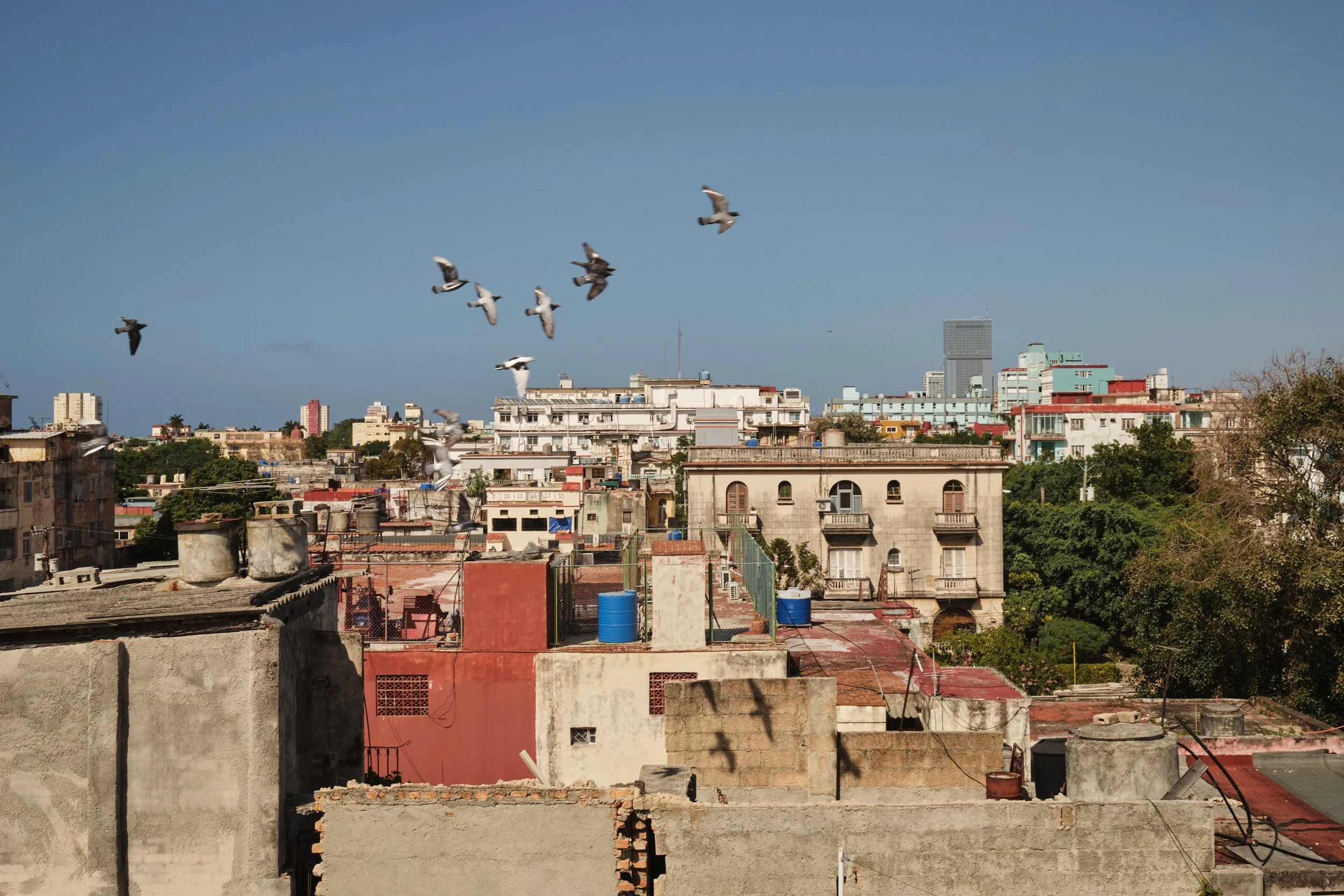
Photo Credit: Natalia Favre
We continue to spotlight the writing of Natalia Favre, a photographer based in Havana. Below is her third dispatch from Havana, written for the US-Cuba News Brief.
Havana Dispatch #3 by Natalia Favre (original in Spanish here)
How do you explain the sensation of watching a nation empty itself?
My friend wants to take pieces of his island with him; that is why he takes photographs. He suspects that time, standing still in his gray landscapes, will slip through his fingers the moment he crosses the ocean.
In the last four years, it is estimated that a quarter of the Cuban population has emigrated – mostly young people, like him. In my ten years on the island, I said goodbye to almost everyone who taught me how to understand its many contradictions.
Laura was one of them. I interviewed her while working on a project about the exodus told through stories of long-distance love. One day, while browsing through an old family album, lying on the bed that had belonged to her sister, she told me:
“Everyone is leaving, looking for a better future; my sister left looking for a better future. Will I see her again? Will I have the chance to leave Cuba, or will she return?”
It was 2022, and her older sister, Maydel, had embarked on a long journey from Nicaragua toward the United States. Sometime later, I visited her in Las Vegas. She was living with her great-aunt, whom she cared for. Regarding the journey, she only told me that what she experienced marked her forever: “When you leave Cuba, you know you are going, but you don’t know what is going to happen to you.”
Today, the family home in Guanabacoa where they all once lived together stands empty. It has been over a year since Laura and her parents emigrated to Spain. They still haven’t been able to reunite with Maydel.
As my generation vanishes from the island, I devote myself to the almost impossible task of finding new friends. I do so carefully, as if every bond were the beginning of a goodbye.
US-CUBA NEWS BRIEF
On April 2, Cuba’s government announced that it would pardon and release 2,010 prisoners. While presented as a humanitarian measure, human rights organizations report that so far, none of those released were political prisoners. The group primarily included young people, women, individuals over the age of 60, foreign nationals, Cubans living abroad, and those nearing the end of their sentences. Cuba’s government explicitly excluded individuals convicted of ‘crimes against authority.’
At least 775 political prisoners remain behind bars, according to Justicia 11J, a human rights organization tracking political prisoners in Cuba. Another organization, Prisoners Defenders, has recorded 736 prisoners of conscience, 443 condemned of conscience, and 35 cases of other political prisoners. Notably, Justicia 11J documented the release of three political prisoners in the days leading up to the announcement, though it remains unclear whether those cases were connected to the government’s broader pardon.
The absence of political prisoners in this release is striking, particularly given the size of the release and the recent precedent. Cuba began granting pardons in 2011 and has carried out five rounds since. Havana claims it has released over 11,000 prisoners in total. The last time Cuba released inmates was March 12, 2026, when it released 51 prisoners. Justicia 11J confirmed and identified at least 20 of the 51 as political prisoners. Before that, the last large prisoner release was on March 10, 2025, when Cuba fulfilled a Vatican-brokered deal that was finalized at the end of the Biden administration and resulted in the release of 553 prisoners, over 200 of whom were political prisoners.
It is possible that Cuba’s government is reserving the release of political prisoners as leverage in future negotiations with the US. Although Cuban officials have framed the April 2 measure as a sovereign decision tied to the religious observance of Holy Week, the timing suggests it may also be linked to ongoing conversations with the US.
The timing of the release is notable, coinciding with the arrival of a sanctioned Russian oil tanker on March 31 carrying at least 700,000 barrels of crude. While the two developments may be unrelated, their proximity raises questions about whether they form part of a broader set of understandings or parallel dynamics.
This shipment is expected to provide only short-term relief, likely sustaining the country’s energy needs through mid-April once refined. Reuters also reported new information alleging the island received a small shipment from Jamaica in February. Additionally, Cuba reactivated at least two Turkish floating power plants that had been withdrawn due to high operating costs. A second Russian tanker is reportedly en route as well. Despite these efforts, the country’s structural energy shortages remain unresolved, and such shipments offer only temporary mitigation.
Beyond the news of the prisoner release, the pace of the Cuba news cycle has slowed considerably over the past two weeks, which is no doubt influenced by the escalating war in Iran. Reporting suggests that U.S. policy focus has shifted accordingly. Regardless, Cuba is likely to reemerge as a priority, particularly as U.S. policymakers seek more “manageable” foreign policy opportunities. Recent remarks by Secretary of State Marco Rubio at the G7 meeting demonstrate a continued hardline stance, emphasizing that meaningful economic change in Cuba is contingent on political transformation and telling reporters to question reports they see about the prospects of an economic deal.
While the US remains busy in the Middle East, Cuban officials have been making the rounds on various major media outlets, including an Al Jazeerainterview with Deputy Foreign Minister Josefina Vidal Ferreiro, someone who has been involved in negotiations with the US, as well as a handful of interviews with President Díaz-Canel. One with Newsweek aired on April 7, and another on NBC’s Meet the Press aired partially yesterday, with the full interview to be released on Sunday. President Díaz-Canel also appeared in a lengthyinterview with Canal Red, which was republished on multiple Cuban state media websites, including Cubadebate.
Throughout interviews, President Díaz-Canel frequently reiterated claims of defending the island in the case of military action, rejected the idea of changing Cuba’s political system, and, on Meet the Press, refused to agree he would step down even if his country’s survival depended on it.
Domestically, conditions on the island continue to deteriorate. Despite widespread frustration with both Cuba’s government and U.S. policy toward Cuba, there is little indication that the conditions for large-scale popular mobilization are currently in place. Most Cubans remain focused on day-to-day survival amid persistent shortages of food, fuel, electricity, and water. For ordinary Cubans, the situation remains defined by uncertainty and scarcity.
Keep Up with CEDA
📷 MEDIA MENTION: CEDA Executive Director María José Espinosa spoke onBBC News Live to offer a firsthand look at the reality on the island today. “Both governments bear responsibility and ordinary Cubans are paying the price,” she explained. Watch part 1 and part 2 of her interview.
📷 MEDIA MENTION: María José Espinosa also appeared on ABC News Live, emphasizing that“[Cubans] want to see change but they want to see peaceful change.” Watch part 1 and part 2 of her interview.
✉️ LETTER SIGN-ON: CEDA joined 84 international organizations to call on Congress to block funding for detention operations and close Guantánamo for good. Since February 2025, over 700 immigrants have been temporarily detained at both GMOC and Camp 6, part of the military detention facility.
🖥️ RECENT WEBINAR: CEDA hosted a webinar on April 7 with two Cuban entrepreneurs titled, “Today in Cuba: A Ground-Level Perspective from Cuban Entrepreneurs.” Watch a recording here.
🌎 AMÉRICA CAMPAIGN: CEDA and Cuba-based fashion brand Clandestina have released a line of América merchandise that supports and amplifies the campaign’s message of a more inclusive vision of the Americas. Shop América today.
US-CUBA NEWS
Congressional Delegation Travels to Cuba
Representatives Pramila Jayapal (WA-7) and Jonathan Jackson (IL-1) traveled to Cuba from April 1 to 5 on a congressional delegation, after which, the pair called for an immediate end to the U.S. fuel blockade on Cuba. During their visit, they met with Cuba’s President Miguel Díaz-Canel, Foreign Minister Bruno Rodríguez Parrilla, members of Cuba’s parliament, and a wide range of voices, including families, religious leaders, entrepreneurs, civil society organizations, and dissidents. They described witnessing firsthand the humanitarian toll of the blockade and characterized it as “cruel collective punishment” that must stop immediately. They emphasized the need for both nations to enter genuine negotiations.
President Díaz-Canel wrote on Monday that upon meeting with Representatives Jayapal and Jackson, he denounced the damage caused by the blockade and reiterated his government’s willingness to engage in bilateral dialogue to resolve existing differences. The visit drew criticisms from Republican lawmakers, most notably Representative Carlos Giménez (FL-26), who accused the two representatives of supporting a “repressive regime” and called their visit incompatible with their stated commitment to democracy.
House and Senate Democrats Send Letter to Trump on Cuba Policy
Representative Gregory Meeks (NY-5) and Senator Tim Kaine (VA), along with 50 Democratic lawmakers, sent a letter to President Trump on April 2, condemning the administration’s Cuba policy and warning that expanded restrictions are worsening a severe humanitarian crisis on the island. The lawmakers argue that decades of “maximum pressure” have failed to produce political change and that recent measures, particularly those limiting access to energy and healthcare, are accelerating infrastructure collapse, fueling widespread blackouts and shortages, and placing the greatest burden on vulnerable populations such as children, the elderly, and the chronically ill. They urge the administration to reverse course and adopt a new approach toward Cuba.
FBI Technical Team on the Ground in Cuba
On March 31, a technical team from the Federal Bureau of Investigation (FBI) arrived in Cuba to launch an independent investigation into the February 25 deadly shootout between Cuba’s border patrol and a Florida-tagged speedboat carrying Cuban exiles. U.S. officials confirmed the team’s arrival on Wednesday but did not provide additional details.
The incident occurred when 10 Cuban nationals attempted to enter Cuba by speedboat, at night, armed with nearly 13,000 rounds of ammunition, 13 rifles, and 11 pistols, according to Cuba’s government. Additionally, the government said the men fired first and that soldiers returned fire, killing four suspects and injuring six others, including a crew member aboard Cuba’s military vessel. A fifth suspect later died from his injuries. Cuba’s government has characterized the incident as a terrorist attack.
In March, Cuba’s President Díaz-Canel said FBI agents would be permitted to carry out an investigation on the island in cooperation with Cuban officials. Secretary of State Marco Rubio affirmed that the speedboat incursion was not a U.S. operation and that no U.S. government personnel were involved. A U.S. official told CNN that investigators will independently verify what happened and will not base decisions on information provided by Cuba’s government.
IN CUBA
Russian Oil Tanker Reaches Cuba
On March 31, a sanctioned Russian tanker, the Anatoly Kolodkin, docked at the Matanzas oil terminal carrying at least 700,000 barrels of Russian crude oil, a medium-sour crude well-suited for Cuba’s aging refineries. The shipment temporarily ended a de facto U.S. oil blockade that had left Cuba without an oil tanker for three months, deepening an energy crisis marked by widespread blackouts across the country. It will take several days for the crude to be processed into motor fuel, diesel, and fuel oil for power generation. President Díaz-Canel welcomed the delivery, having previously warned that the prolonged absence of fuel shipments was severely exacerbating conditions for Cubans on the island.
President Trump said he had “no problem” with the shipment, adding that he would allow any country to send oil to Cuba “for humanitarian reasons.” He questioned Cuba’s government’s ability to sustain itself, suggesting the island is “next” and on the verge of collapse. White House Press Secretary Karoline Leavitt clarified that the decision was made on a “case-by-case” basis and did not represent a formal change in sanctions policy, adding that the US still reserves the right to seize vessels that violate sanctions. Representative María Elvira Salazar (FL-27) echoed a similar stance, noting that a single shipment would not resolve the broader situation while reaffirming her support for regime change in Cuba.
Russia’s Energy Minister Sergei Tsivilev confirmed a second oil shipment is on its way to Cuba, citing its longstanding alliance with the island. Russian Foreign Ministry spokesperson Maria Zakharova stated that assistance to Cuba would continue, and Russia’s government spokesman Dmitry Peskov emphasized Russia’s sense of duty toward its Cuban partners. Details on the timing and volume of the second shipment have not yet been released, and the White House has not confirmed whether it will permit the vessel to dock.
UN Report Details the Deterioration of Essential Services in Cuba
A new report from the United Nations (UN) highlights the deepening deterioration of essential services in Cuba, warning that humanitarian needs remain “acute and persistent.” According to the report, the country faces a backlog of more than 96,000 surgeries, including roughly 11,000 involving children, while up to 60 percent of essential medicines are unavailable. Access to basic services is also under strain: about one million people rely on water trucking, an increasingly unreliable solution amid ongoing fuel shortages, while 1.26 million experience reduced water service, with 84 percent of water systems dependent on electricity. The crisis extends to food and education, as domestic food production has fallen by more than 50 percent since 2021, placing one million people at risk of food assistance disruptions. Meanwhile, over 30,000 children have missed routine vaccinations and some 400,000 students face shortened school days. “The humanitarian consequences continue every day, despite recent efforts to deliver fuel; the situation comes on top of multiple shocks,” said UN official Francisco Pichon.
Cuba Introduces New High-Denomination Banknotes
Due to high inflation, Cuba has introduced two new high-denomination banknotes: 2,000 and 5,000 Cuban pesos. The 5,000 peso note entered circulation on April 1. The government framed the change as an “update of the country's monetary system.” Previously, the highest denomination was 1,000 pesos, forcing many Cubans to carry large amounts of cash to afford basic necessities. Some projections put Cuba's annual inflation rate at 70 percent in 2025, but the government puts it at 14 percent. The new notes will feature Mariana Grajales, a figure in Cuba’s independence movement, and Celia Sánchez, who was a key leader in the Cuban revolution.
Cuban Women Protest
On April 7, hundreds of Cuban women gathered in Havana to protest U.S. sanctions and the oil blockade imposed by the Trump administration. The rally was organized by the Federation of Cuban Women, a government-aligned organization, to honor Vilma Espín. Espín founded the federation and was the late wife of former President Raúl Castro. The demonstration was led by Deputy Prime Minister Inés Maria Chapman, Deputy Foreign Minister Josegina Vidal, and Espín’s daughter Mariela Castro. Vidal characterized the blockade as a form of collective punishment under international law. Among the attendees was Leydys de la Cruz, a 57-year-old seamstress, who urged Trump to “leave us in peace,” describing the situation as dire due to the blockade.
CUBA’S FOREIGN RELATIONS
Mexico Aid Ships Lost then Found
On March 28, two sailboats carrying humanitarian aid from southern Mexico to Cuba arrived safely in Havana after going missing for several days due to bad weather. The vessels, the Friendship and the Tiger Moth, were part of the “Nuestra America Convoy,” a grassroots initiative that loaded supplies, including rice, beans, baby formula, medicine, and energy-related goods in Mexico before departing for the 200-mile journey to Havana.
The boats had departed from Isla Mujeres, in Mexico’s Quintana Roo state, with an expected arrival between March 24 and 25. On March 26, after the vessels failed to arrive as scheduled and lost communication, Mexico’s navy activated a search-and-rescue operation. Mexico’s President Claudia Sheinbaum expressed concern over the missing boats during the search, confirming that authorities were searching for them. Similarly, President Díaz-Canel affirmed that the country was doing everything to save its “brothers in arms.” Mexican authorities notified the U.S. Coast Guard but did not ask it to participate in search efforts. They later confirmed that the two vessels had “safely transited to Cuba.”
After the two ships went missing, a naval aircraft located the two catamarans approximately 80 nautical miles northwest of Havana, Mexico’s navy dispatched a vessel to the area to provide support while crews maintained radio communication. The nine crew members of various nationalities on board were never in critical danger, as poor weather conditions had forced the boats to take a longer route.
Recommended Reading, Listening & Viewing:
Go | Articulo 20 by Terrence Levens: Esterio Segura in New York: Father and Son 30 Years Later
Watch | Cuba Study Group: “Without power, there is no country."
Watch | Belly of the Beast: Exclusive Interview | U.S. Lawmakers Pramila Jayapal & Jonathan Jackson Speak in Cuba
Listen | Cimafunk & La Tribu: LIVE in Criteria Studios Miami
Read | The New York Times: With Cuba Under Pressure, the Castro Dynasty Is Making a Comeback
Read | The New York Times: As Trump Squeezes Cuba, U.S. Military Exists in a Bubble
Read | Responsible Statecraft: What's behind Trump's 180-degree turn, allowing Russian oil to Cuba?
Read | The Economist: For Donald Trump, Cuba is everything Iran is not
Read | The New York Times: Trump Isn’t Taking Cuba. He’s Starving It.
Read | The Conversation: Canada and Mexico must work together to help Cuba survive its dire humanitarian crisis
Read | Lawfare: Congress: Give the President Discretion to Remove the Cuba Embargo
Read | Financial Times: Soul searching amid Cuba’s latest crisis
Read | Inkstick: As Trump Looks to Suffocate Havana, Cubans Feel the Hurt
