
The Havana Dispatch by Natalia Favre
CEDA’s mission is to amplify the voices of communities impacted by policy across Latin America and the Caribbean. In a special five-part collaboration within the US-Cuba News Brief, CEDA partners with photojournalist Natalia Favre to present The Havana Dispatch. Through this series, Favre offers exclusive, on-the-ground perspectives from Havana, capturing the realities of daily life on the island. Together, these dispatches aim to provide readers with a deeper, more human understanding of contemporary Cuba.
Dispatch #5 — May 14, 2026
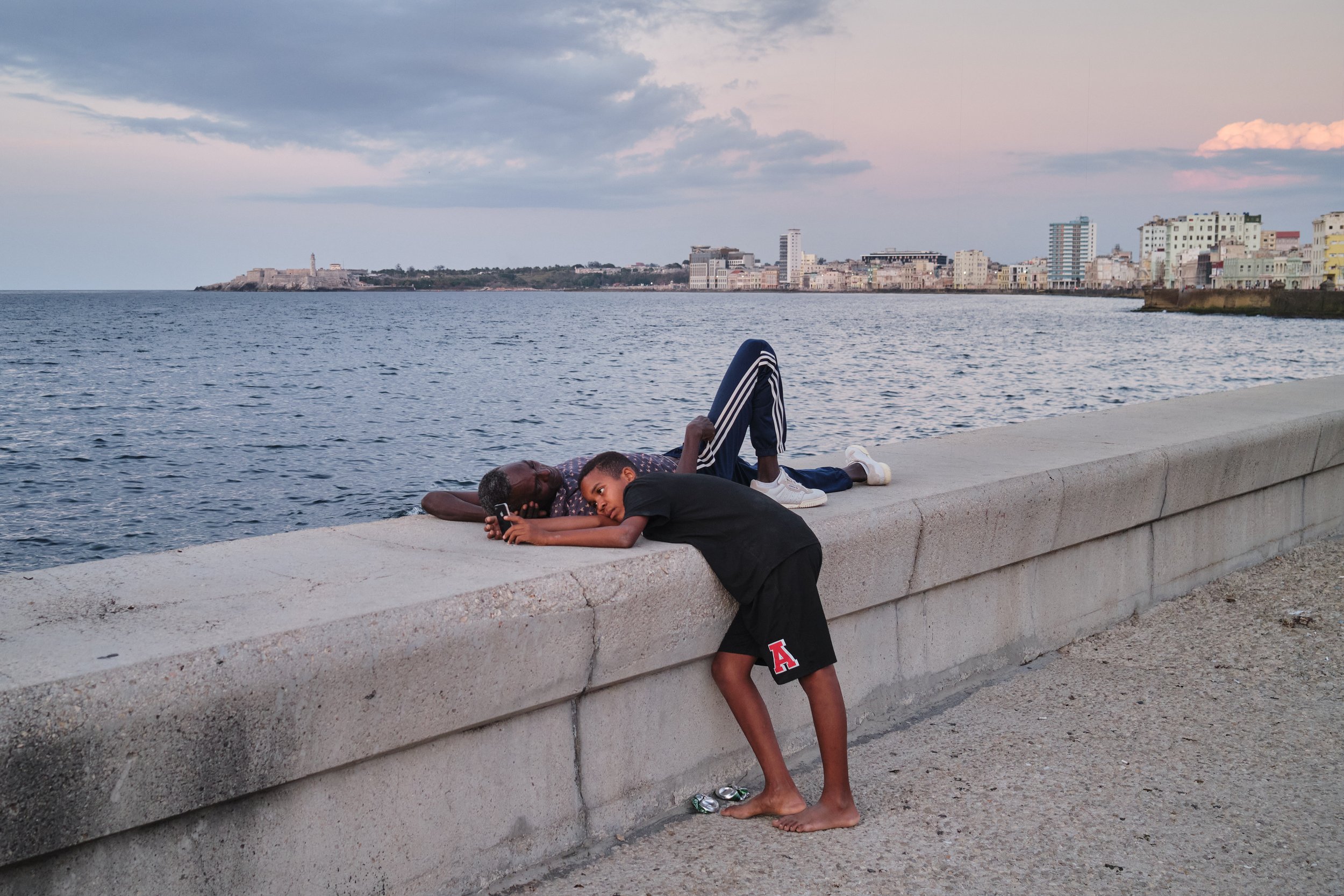
Photo by Natalia Favre
Español:
La sensación es similar a la de la pandemia. Cuando el sol comenzaba a bajar después de todo un día encerrada en la casa, corría loma abajo para ver el horizonte antes de que mi cabeza explotara. No era mucho el tiempo que teníamos. A las ocho empezaba la cuarentena y, como yo, cientos llegaban al Malecón a respirar la brisa salada y expulsar el calor que absorbían nuestros cuerpos entre cuatro paredes. Hoy, más de cinco años después y sin COVID circulando, la ansiedad colectiva se parece mucho a la de ese momento.
No es nuevo que el Malecón sea “el gran sofá de La Habana”, pero cuando no hay electricidad ni para hacer circular el aire húmedo y tibio de los ventiladores, se convierte en refugio y escape. En el trayecto de más de siete kilómetros que va desde el Vedado hasta la Habana Vieja, pasando por Centro Habana, o viceversa, me encuentro escenas de todo tipo.
Los domingos son los días más ruidosos. En la punta de Prado y Malecón, se celebra un tambor a Yemayá. Bajando por las escaleras que llevan directo al diente de perro, esas rocas filosas que abundan en la costa habanera, los percusionistas golpean los cueros y una multitud canta en yoruba. Alrededor de la celebración, algunas familias se bañan en el mar y un grupo de jóvenes conversa mientras comparte una botella de ron.
Llegando a Centro Habana, un padre o abuelo está acostado en el muro y mira el cielo con los ojos perdidos; sabrá Yemayá qué está pensando. Descalzo y apoyado sobre su hombro está su hijo o su nieto; no lo sé, porque no quise interrumpirlos.
En La Isla en peso, el poema que Virgilio Piñera escribió en 1943 y que pareciera que pudiera haber sido escrito hoy, “la maldita circunstancia del agua por todas partes”, aparece tanto como la tragedia de la condición geográfica de esta isla, como por el encierro que a veces significa vivir en ella. El mar, escondido detrás del muro de cemento o furioso inundándolo todo a su paso, es el límite y el abismo.
Empezó mayo y el noticiero advierte que se avecina la primera ola de calor. Los apagones no dan tregua y la crisis tiene a la gente con los bolsillos flacos. Me pregunto: ¡Qué sería de los habaneros sin el Malecón?
English:
The sensation is similar to that of the pandemic. When the sun began to dip after a full day cooped up inside the house, I would run down the hill to catch a glimpse of the horizon before my head exploded. We didn’t have much time. Quarantine began at eight o’clock, and, like me, hundreds would flock to the Malecón to breathe in the salty breeze and release the heat our bodies had absorbed within four walls. Today, more than five years later and with no COVID circulating, the collective anxiety bears a striking resemblance to that of those days.
It is nothing new for the Malecón to be known as “Havana’s great sofa”; yet, when there isn’t enough electricity to even power the fans that circulate the humid, warm air, it transforms into both a refuge and an escape. Along the stretch of more than seven kilometers running from Vedado to Old Havana, passing through Centro Habana, or vice versa, I encounter scenes of every kind.
Sundays are the noisiest days. At the intersection of Prado and the Malecón, a tambor is held in honor of Yemayá. Down the steps that lead directly to the diente de perro, the collection of sharp rocks along the Havana coast, percussionists beat their drums while a crowd sings in Yoruba. Surrounding the celebration, families bathe in the sea, and a group of young people chat while sharing a bottle of rum.
Upon reaching Centro Habana, a father, or perhaps a grandfather, lies stretched out on the seawall, gazing at the sky with a lost look in his eyes; only Yemayá knows what he is thinking. Barefoot, and leaning against his shoulder, sits his son or perhaps his grandson; I cannot say for sure, as I wished to not interrupt them.
In La Isla en peso, the poem Virgilio Piñera wrote in 1943, which feels as though it could’ve been written today, "the accursed circumstance of water on all sides" represents both the tragedy inherent in this island’s geographical condition and the sense of confinement that living here sometimes entails. The sea, hidden behind the concrete wall, or furiously flooding everything in its path, is both the boundary and the abyss.
May has begun, and the news warns that the first heatwave is approaching. The blackouts offer no respite, and the crisis has left people with empty pockets. I ask myself: What would become of the Habaneros without the Malecón?
Dispatch #4 — May 1, 2026
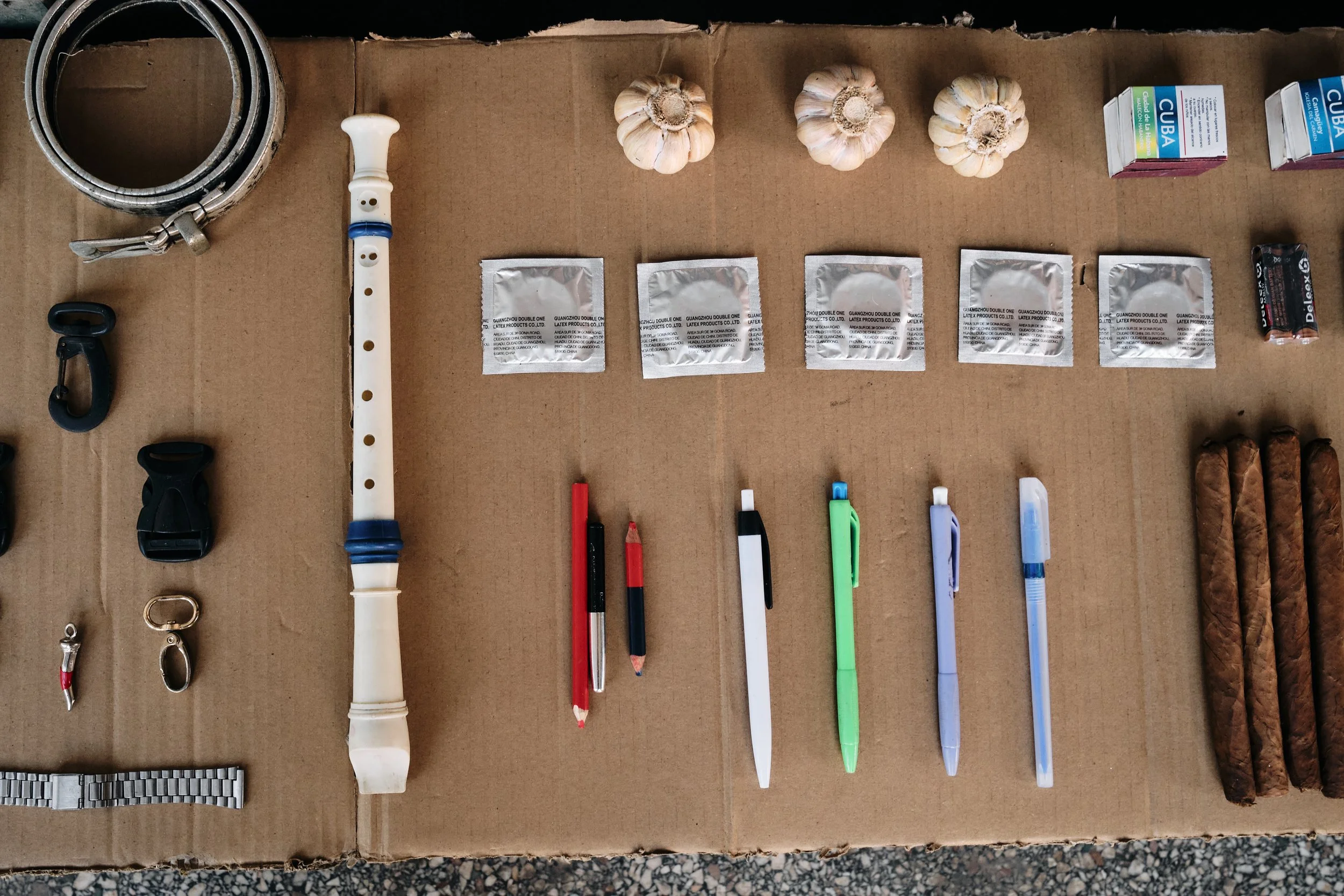
Photo by Natalia Favre
Español:
Diógenes tiene 64 años y, durante gran parte de su vida, trabajó en el cementerio de Colón. Cada día camina desde su casa, en el municipio de Playa, hasta la esquina de 23 y 12, en el Vedado. Allí despliega una manta en la que conviven ganchos de pelo, novelas rusas, soldaditos de plástico y medicamentos.
En La Habana, cada vez hay más personas como él que, debido a la falta de empleo o salarios insuficientes, encuentran una economía alternativa en la compraventa de objetos de cualquier tipo.
José tiene 75 años y se pasa los días sentado en un portal de la calle Monte. Como Diógenes, es vendedor ambulante. Los 3000 pesos cubanos que cobra de jubilación (unos 6 dólares), se esfuman demasiado rápido. Su manta presenta una disposición milimétrica: una flauta blanca ocupa el centro; a su alrededor, tres cabezas de ajo, cinco paquetes de preservativos, algunas cajas de fósforos, lápices y tabacos. Todo cuidadosamente dispuesto.
Para Gerardo, de 68, la venta callejera representa un ingreso extra. Por las noches trabaja como guardia de seguridad, pero como a casi todos, el salario no le alcanza. Durante el día vende en la calle Galiano y gana, en promedio, unos 2.000 pesos diarios, casi la mitad de su salario formal.
Enfrente se ubica Yoandry, un bartender de 31 años que solía trabajar en un restaurante de La Habana Vieja y perdió su empleo con la caída del turismo. Su espacio es el más caótico: sobre el cemento abrasador del mediodía, objetos disímiles yacen librados al azar. La gente que circula por el lugar se acerca con curiosidad y se forma un pequeño tumulto alrededor.
Alguien le advierte que hay policías cerca. Entre vendedores se conocen y se cuidan. Las multas pueden llegar a 10.000 pesos, mucho más de lo que pueden reunir en un día. Rápidamente, comienza a guardar su mercancía. Mientras tanto, un niño se prueba unas antiparras gastadas y su padre pregunta por una radio desvencijada. Yoandry asegura que aún funciona, pero el hombre no se convence y sigue su camino.
La sucesión de mantas bajo el dorado atardecer habanero remite a naturalezas muertas: objetos dispersos conforman el archivo material de la ciudad, y se ofrecen como símbolos de una realidad cada vez más fragmentada.
English:
Diógenes is 64 years old and, for much of his life, worked at the Colón cemetery. Every day he walks from his home in the municipality of Playa to the corner of 23rd and 12th Streets in Vedado. There he lays out a blanket where hair clips, Russian novels, plastic toy soldiers, and medicines all coexist.
In Havana, there are increasingly more people like him who, due to lack of employment or insufficient wages, find an alternative economy in buying and selling objects of all kinds.
José is 75 years old and spends his days sitting in a doorway on Monte Street. Like Diógenes, he is a street vendor. The 3,000 Cuban pesos he collects as a pension (about 6 dollars) disappear far too quickly. His blanket is arranged with meticulous precision: a white flute occupies the center; around it, three heads of garlic, five packets of condoms, some boxes of matches, pencils, and cigars. Everything is carefully laid out.
For Gerardo, 68, street vending represents extra income. At night he works as a security guard, but like almost everyone, his salary is not enough. During the day he sells on Galiano Street and earns, on average, around 2,000 pesos a day — nearly half his formal wage.
Across from him is Yoandry, a 31-year-old bartender who used to work at a restaurant in Old Havana and lost his job with the collapse of tourism. His space is the most chaotic: on the scorching midday concrete, mismatched objects lie scattered at random. People passing by approach with curiosity and a small crowd forms around him.
Someone warns him that police are nearby. Among vendors, they know and look out for each other. Fines can reach 10,000 pesos — far more than they can earn in a day. He quickly begins to pack up his merchandise. Meanwhile, a child tries on a worn pair of goggles and his father asks about a battered radio. Yoandry insists it still works, but the man is not convinced and moves on.
The succession of blankets beneath the golden Havana sunset evokes still life paintings: scattered objects make up the material archive of the city, offered as symbols of an increasingly fragmented reality.
Dispatch #3 — April 10, 2026
Photo by Natalia Favre
Español:
¿Cómo explicar la sensación de ver un país vaciarse?
Mi amigo quiere llevarse pedazos de su isla consigo; por eso fotografía. Sospecha que el tiempo, detenido en sus paisajes grises, se escurrirá entre sus manos una vez que cruce el océano.
En los últimos cuatro años, se calcula que una cuarta parte de la población cubana ha emigrado, principalmente jóvenes, como él. En mis diez años en la isla, me despedí de casi todas las personas que me enseñaron a entender sus múltiples contradicciones.
Laura fue una de ellas. La entrevisté mientras trabajaba en un proyecto sobre el éxodo contado a través de historias de amor a la distancia. Un día, mientras ojeaba un viejo álbum familiar, acostada en la cama que había sido de su hermana, me dijo:
“Todo el mundo se va, buscando un mejor futuro, mi hermana se fue buscando un mejor futuro.
¿La volveré a ver?
¿Tendré posibilidad de salir de Cuba, o ella volverá?"
Era 2022, y su hermana mayor, Maydel, había emprendido una larga travesía desde Nicaragua hacia Estados Unidos. Tiempo después, la visité en Las Vegas. Vivía con su tía abuela, a quien cuidaba. De la travesía, solo me contó que lo que vivió la marcó para siempre: “Cuando sales de Cuba, tú sabes que te vas, pero no sabes lo que te va a pasar”.
Hoy, la casa familiar de Guanabacoa donde alguna vez vivieron todos juntos, está vacía. Hace más de un año que Laura y sus padres emigraron a España. Todavía no han podido reencontrarse con Maydel.
Mientras mi generación se esfuma de la isla, me aboco a la tarea casi imposible de encontrar nuevos amigos. Lo hago con cuidado, como si cada vínculo fuera el inicio de una despedida.
English:
How do you explain the sensation of watching a nation empty itself?
My friend wants to take pieces of his island with him; that is why he takes photographs. He suspects that time, standing still in his gray landscapes, will slip through his fingers the moment he crosses the ocean.
In the last four years, it is estimated that a quarter of the Cuban population has emigrated - mostly young people, like him. In my ten years on the island, I said goodbye to almost everyone who taught me how to understand its many contradictions.
Laura was one of them. I interviewed her while working on a project about the exodus told through stories of long-distance love. One day, while browsing through an old family album, lying on the bed that had belonged to her sister, she told me:
"Everyone is leaving, looking for a better future; my sister left looking for a better future. Will I see her again? Will I have the chance to leave Cuba, or will she return?"
It was 2022, and her older sister, Maydel, had embarked on a long journey from Nicaragua toward the United States. Sometime later, I visited her in Las Vegas. She was living with her great-aunt, whom she cared for. Regarding the journey, she only told me that what she experienced marked her forever: “When you leave Cuba, you know you are going, but you don’t know what is going to happen to you.”
Today, the family home in Guanabacoa where they all once lived together stands empty. It has been over a year since Laura and her parents emigrated to Spain. They still haven’t been able to reunite with Maydel.
As my generation vanishes from the island, I devote myself to the almost impossible task of finding new friends. I do so carefully, as if every bond were the beginning of a goodbye.
Dispatch #2 — March 27, 2026
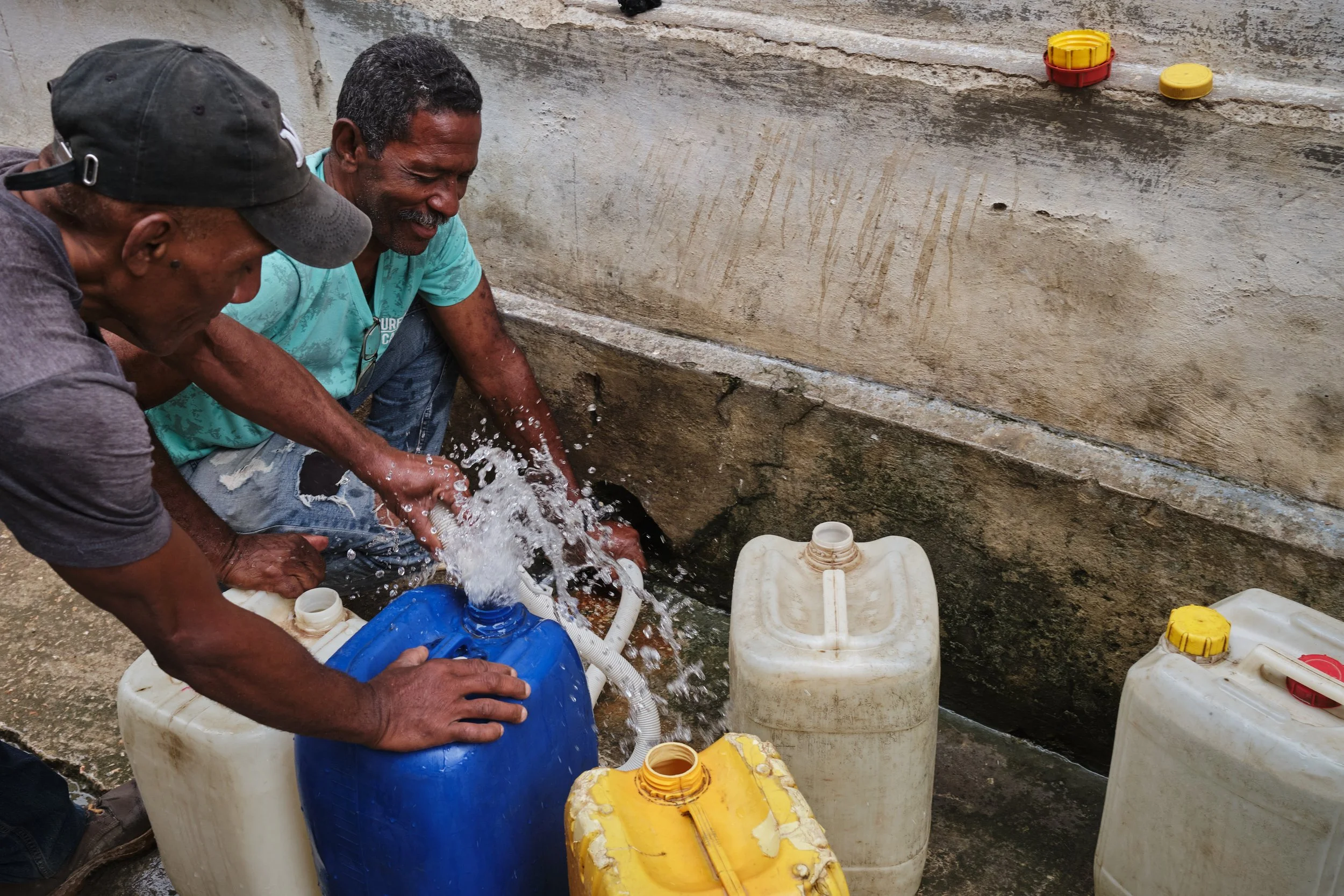
Photo by Natalia Favre
Español:
Tengo un amigo con el que algunos días a la semana salimos a caminar y hacer fotos. Él dice que es lo único que le despeja la cabeza y le ayuda a olvidar los problemas cotidianos. En el apartamento donde vive con su mamá y su abuela, al otro lado del túnel de La Habana, casi siempre hay luz. Al igual que en La Habana Vieja, el sistema eléctrico es soterrado y, a menos que haya un colapso del SEN, la luz no se corta.
En la casa de mi amigo, la maldición es otra; allí hace días que no entra agua.
Esa tarde conocimos a Pablo, un vecino de La Habana Vieja que llevaba más de dos semanas sin agua. Lo encontramos arrastrando un carrito improvisado con un tablón de madera sobre dos pares de ruedas viejas por la calle Empedrado. Arriba del tablón había seis bidones vacíos. Pablo pidió su turno en la cola para rellenarlos y se paró a esperar.
En esa calle hay una pila pública de la que sí sale agua. Sobre el piso mojado hay un hombre sentado con un cigarro en la boca. Sus manos presionan con fuerza la manguera que está encajada en la pila para que no se zafe. Tiene una pequeña bomba inventada que hace que el agua suba hasta los tanques que trae para llenar, que están arriba de un triciclo.
El hombre da una pitada al cigarro y la manguera se desprende. El agua salta en todas direcciones y estallan las risas.
Cuando llega su turno, Pablo llena sus bidones y carga con ellos unas cuantas cuadras hasta su apartamento, donde lo espera su mujer. Está cansado, perdió la cuenta de la cantidad de viajes que hizo hoy. Además de su consumo personal, Pablo vende bidones a vecinos que no pueden acercarse a la pila pública. Cobra 200 pesos por cada uno y dice que lo hace tanto para ayudar como para tener un dinero extra para comprar la comida.
Son días grises en La Habana. Un inusual frente frío en la mitad de marzo azota las calles con vientos que hacen volar la basura que se agolpa en las esquinas. Vuelan envoltorios de dulces, botellas vacías y moscas. Nos despedimos de Pablo y seguimos caminando sin rumbo, persiguiendo la luz en una ciudad que se siente cada día más oscura.
English:
I have a friend with whom I go out walking and taking photos a few days a week. He says it’s the only thing that clears his head and helps him forget daily problems. In the apartment where he lives with his mother and grandmother, on the other side of the Havana tunnel, there is almost always power. Just like in Old Havana, the electrical system is underground, and unless there is a total collapse of the SEN (National Electric System), the power doesn't go out.
In my friend's house, the curse is a different one; water hasn't entered the home for days.
That afternoon we met Pablo, a neighbor from Old Havana who had been without water for more than two weeks. We found him dragging an improvised cart—a wooden plank on two pairs of old wheels—down Empedrado Street. On top of the plank were six empty jugs. Pablo asked for his place in line to refill them and stood there waiting.
On that street, there is a public tap that actually has water. A man sits on the wet ground with a cigarette in his mouth. His hands press firmly against the hose fitted into the tap so it doesn't slip off. He has a small, homemade pump that forces the water up into the tanks he brought to fill, which sit atop a tricycle. The man takes a puff of his cigarette and the hose breaks loose. Water sprays in every direction, and laughter erupts.
When his turn comes, Pablo fills his jugs and carries them a few blocks to his apartment, where his wife is waiting. He is tired; he’s lost count of how many trips he’s made today. In addition to his own personal use, Pablo sells jugs to neighbors who can't make it to the public tap. He charges 200 pesos for each and says he does it as much to help out as to have a little extra money for food.
These are gray days in Havana. An unusual cold front in the middle of March lashes the streets with winds that send the trash piled up on the corners flying. Candy wrappers, empty bottles, and flies take flight. We say goodbye to Pablo and keep walking aimlessly, chasing the light in a city that feels darker every day.
Dispatch #1 — March 13, 2026
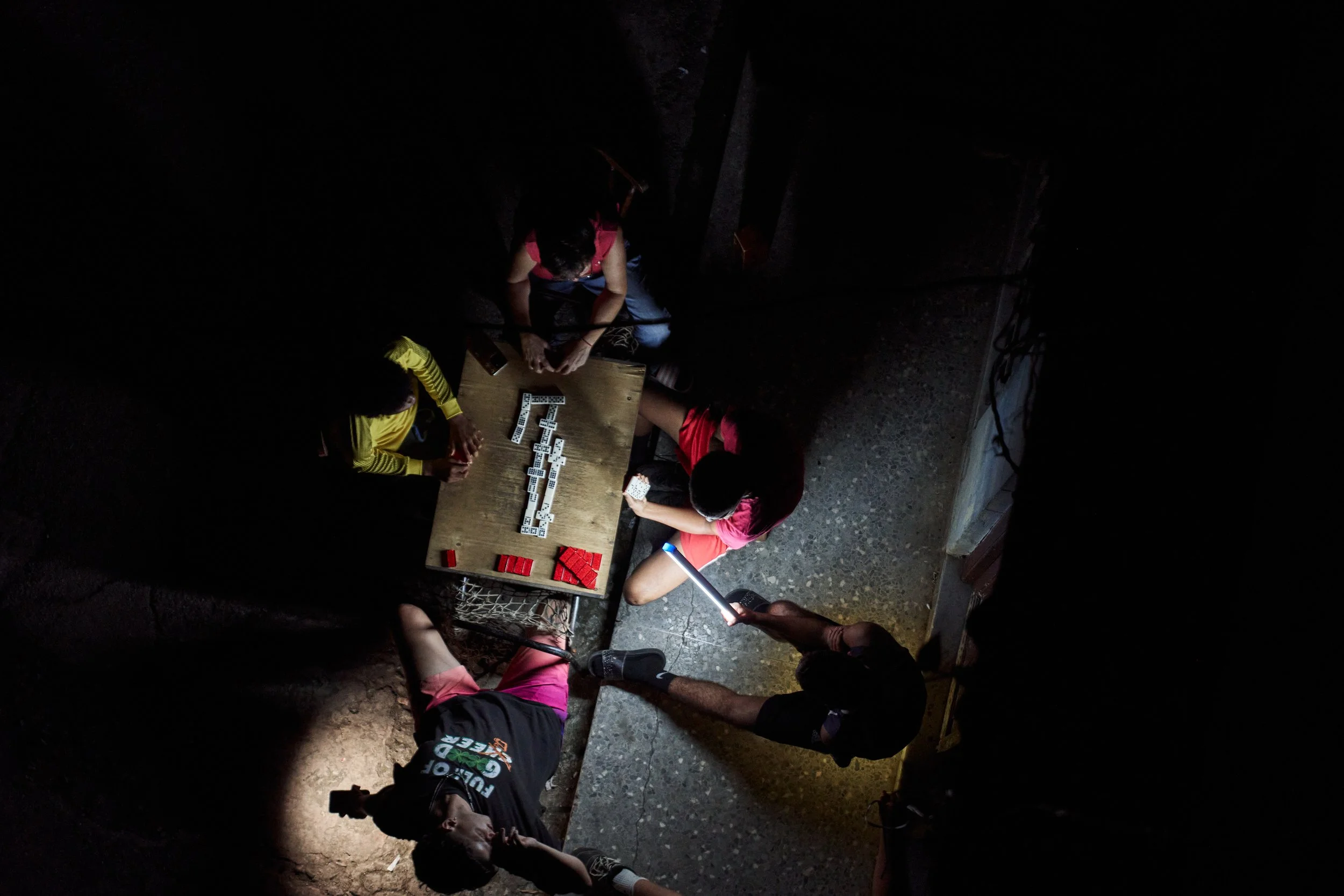
Photo by Natalia Favre
Español:
Otro colapso del sistema eléctrico nacional. En el último año han sido cinco. Es de noche y vuelvo a casa pedaleando. La luz frontal de mi bicicleta parpadea en rojo – tengo que llegar antes de que se apague. En la panadería de la esquina veo un tumulto de lucecitas blancas: son personas esperando a que saquen el pan de la noche.
Cuba atraviesa una profunda crisis energética que afecta todas las esferas de la vida y los apagones se han vuelto parte de la rutina diaria en todas las ciudades del país.
Me apuro a subir la pendiente de la calle 12. Una señora que camina sola, sosteniendo en sus manos unos cuantos panes, se queja de lo calientes que están. Habla alto, como si quisiera que alguien la escuche, pero no hay nadie a su alrededor. “Ay, Cuba, hasta cuándo, Cuba”, dice. Solo yo la oigo, que paso suave subiendo la cuesta.
Delante de mí circula un triciclo eléctrico. Ante la falta de combustible, La Habana se ha llenado de estos vehículos que suenan como latas descuajeringadas. En la parte de atrás caben hasta seis personas, apretadas como sardinas. Un pasajero logra sacar una pierna de entre la maraña de cuerpos y la deja colgando en el aire, como buscando equilibrio, mientras el triciclo sube despacio.
Sorteando los baches que salpican el asfalto, continúo mi camino. Paso frente a algunas casas iluminadas, bendecidas por paneles solares, baterías o EcoFlows. Los sonidos se repiten en cada cuadra del barrio: el marfil de las fichas de dominó chocando con fuerza contra una mesa improvisada y el grito ocasional de un ganador.
La densa oscuridad de los interiores expulsa a mis vecinos a la calle, iluminada por una luna redonda. Los niños no tuvieron escuela y corren por los pasillos con energía contenida mientras un joven músico ensaya acordes tristes en un piano algo desafinado. Los apagones ya no son noticia para los cubanos, que, cansados, cuentan las horas y se resignan a una espera que esta noche se ha vuelto demasiado larga.
English:
Another collapse of the national electrical system. That makes five in the last year. It’s night, and I’m pedaling home. My bicycle’s headlight is flashing red—I have to get home before it dies. At the corner bakery, I see a cluster of tiny white lights: people waiting for the evening bread to be pulled from the bakery’s oven.
Cuba is going through a profound energy crisis that affects every sphere of life, and blackouts have become part of the daily routine in every city across the country.
I speed up the hill on Calle 12. A woman walking alone, clutching a few loaves of bread, complains about how hot they are. She speaks loudly, as if she wants someone to hear her, but there’s no one around. "Oh, Cuba, hasta cuándo, Cuba," she says. Only I hear her as I peddle up the hill.
An electric tricycle pulls up ahead of me. Given the lack of fuel, Havana has filled up with these vehicles that sound like rattling tin cans. Up to six people fit in the back, squeezed in like sardines. One passenger manages to stick a leg out from the tangle of bodies, letting it hang in the air as if searching for balance while the tricycle climbs slowly.
Navigating the potholes that pepper the asphalt, I continue on my way. I pass a few illuminated houses, blessed by solar panels, batteries, or EcoFlows. The sounds repeat on every block of the neighborhood: the ivory of domino tiles slamming hard against an improvised table and the occasional shout of a winner.
The dense darkness of the interiors drives my neighbors out into the street, which is lit by a round moon. The children have no school and run through the hallways with pent-up energy, while a young musician rehearses somber chords on a slightly out-of-tune piano. The blackouts are no longer news to Cubans, who, weary, count the hours and resign themselves to a wait that, tonight, has become far too long.
