
Cubans Bear the Cost of Policymakers' Indecision as Russia Sends Temporary Relief
This week, we continue to spotlight the writing of Natalia Favre, a photographer based in Havana. Below is her second dispatch from Havana, written for the US-Cuba News Brief.
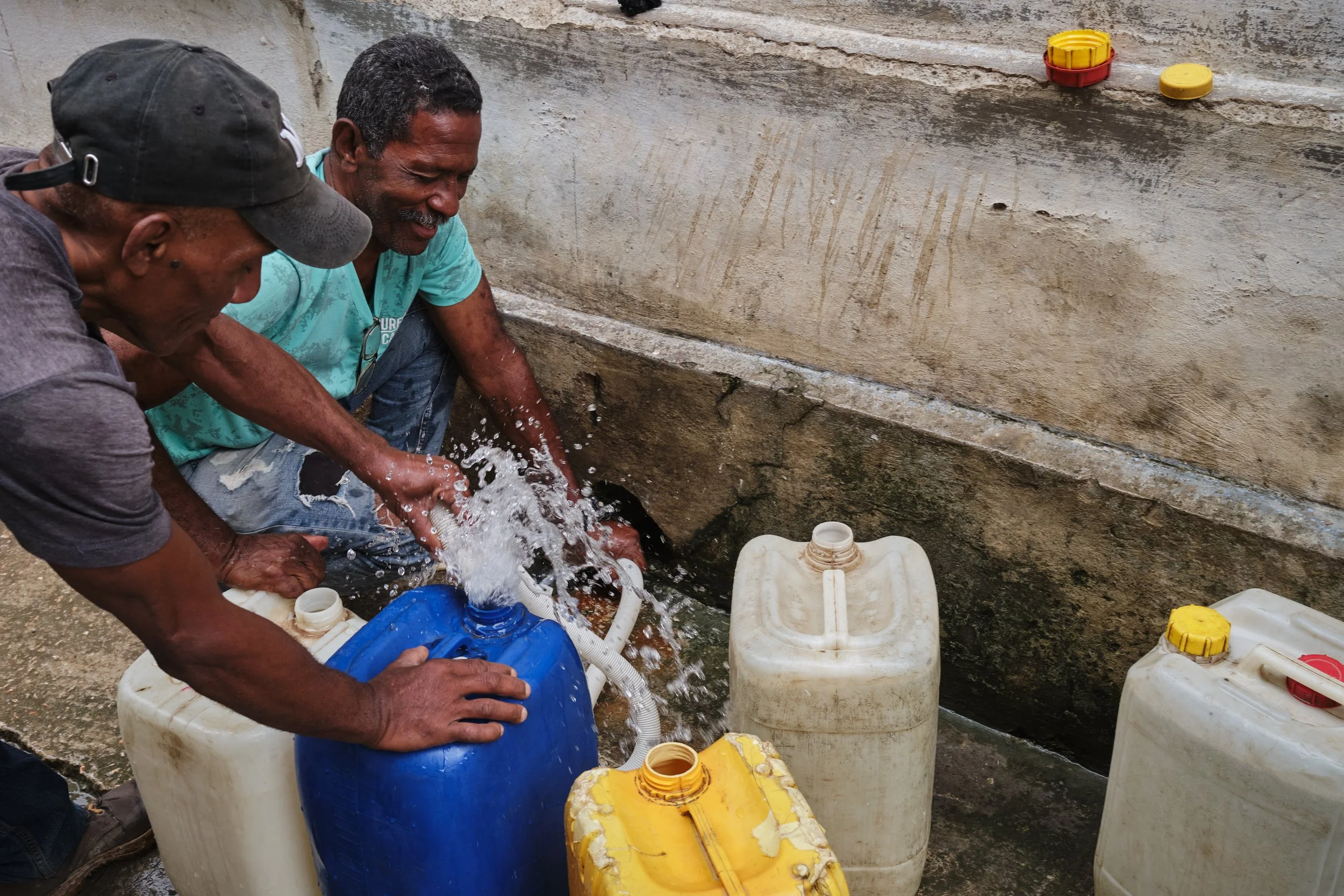
Photo Credit: Natalia Favre
Havana Dispatch #2 by Natalia Favre (original in Spanish is here)
I have a friend with whom I go out walking and taking photos a few days a week. He says it’s the only thing that clears his head and helps him forget daily problems. In the apartment where he lives with his mother and grandmother, on the other side of the Havana tunnel, there is almost always power. Just like in Old Havana, the electrical system is underground, and unless there is a total collapse of the SEN (National Electric System), the power doesn't go out.
In my friend's house, the curse is a different one; water hasn't entered the home for days.
That afternoon we met Pablo, a neighbor from Old Havana who had been without water for more than two weeks. We found him dragging an improvised cart—a wooden plank on two pairs of old wheels—down Empedrado Street. On top of the plank were six empty jugs. Pablo asked for his place in line to refill them and stood there waiting.
On that street, there is a public tap that actually has water. A man sits on the wet ground with a cigarette in his mouth. His hands press firmly against the hose fitted into the tap so it doesn't slip off. He has a small, homemade pump that forces the water up into the tanks he brought to fill, which sit atop a tricycle. The man takes a puff of his cigarette and the hose breaks loose. Water sprays in every direction, and laughter erupts.
When his turn comes, Pablo fills his jugs and carries them a few blocks to his apartment, where his wife is waiting. He is tired; he’s lost count of how many trips he’s made today. In addition to his own personal use, Pablo sells jugs to neighbors who can't make it to the public tap. He charges 200 pesos for each and says he does it as much to help out as to have a little extra money for food.
These are gray days in Havana. An unusual cold front in the middle of March lashes the streets with winds that send the trash piled up on the corners flying. Candy wrappers, empty bottles, and flies take flight. We say goodbye to Pablo and keep walking aimlessly, chasing the light in a city that feels darker every day.
US-CUBA NEWS BRIEF
As conditions on the island reach increasingly dire levels, negotiations between the US and Cuba appear to have stalled, leaving ordinary Cubans to bear the consequences of political indecision. The pace of developments has become almost impossible to track, but the bottom line is stark: Cubans are tired and need a policy change to alter their daily reality. Across the island, electricity is unavailable for reliable stretches of time, access to running water is inconsistent due to its dependence on the electrical grid, and hospitals are facing shortages so severe that preventable deaths are beginning to rise.
At the center of the crisis is fuel. The number of tankers moving between Cuban ports averaged around 50 per month in 2025 but fell to just 11 in March, the lowest level since 2017. Energy usage has also dropped sharply since the start of 2026. Oil remains the island’s lifeline, and energy expert Jorge Piñon has warned of an imminent “zero hour,” meaning that if shipments fail to arrive in March, Cuba could effectively run out of fuel entirely.
There have been limited and insufficient attempts to ease the strain. Reuters reported that U.S. suppliers exported roughly 30,000 barrels of oil to Cuba’s private sector in 2026, following a U.S. decision to allow exports to the private sector. But this represents only a fraction of the country’s daily needs. At the same time, the UN has reportedly urged Washington to allow broader oil imports on humanitarian grounds, but this pressure has yet to translate into meaningful policy change.
Against this backdrop, political tensions continue. Speaking aboard Air Force One, President Donald Trump suggested that a deal with Cuba could come soon, but added that Iran would come first. He further sparked controversy at a White House press conference, stating, “Taking Cuba, that would be a great honor…whether it’s liberating it or taking it.” While U.S. Southern Command Chair General Francis Donovan later clarified before Congress that military action is not under consideration, the remarks nevertheless provoked a sharp response from Havana. Cuba’s President Miguel Díaz-Canel responded on X, writing, “any external aggressor will clash with an impregnable resistance.”
These tensions are unfolding alongside conflicting signals about U.S. strategy. Recent reporting has suggested that Washington is seeking to push President Díaz-Canel from power, a claim that Secretary of State Marco Rubio publicly dismissed as misinformation writing on his personal X account, “The reason so many in US media keep putting out fake stories like this one is because they continue to rely on charlatans & liars claiming to be in the know as their sources.” Notably, he did not explicitly deny that the administration requested that President Díaz-Canel step down. For its part, Cuba’s government has confirmed that talks are ongoing but firmly rejected any scenario in which President Díaz-Canel steps down. President Díaz-Canel also recently confirmed what many Cuba experts already knew: that Raúl Castro is still an active part of Cuba’s government, stating “[Raúl Castro] has guided how we should conduct this dialogue process.”
Cuban officials have sharpened their rhetoric as negotiations stall. Deputy Foreign Minister Carlos Fernández de Cossío stated on NBC’s Meet the Press that Cuba is preparing “for the possibility of military aggression,” even as the country’s military capacity remains limited. Reports also recently surfaced that Cuba’s government is seeking help from the Vatican in negotiations with the US. Meanwhile, U.S. public opinion appears to be shifting, with recent polling indicating growing disapproval of both the de facto oil blockade and the U.S. embargo.
On the ground, the most immediate question is not political, it is logistical: whether oil will arrive in time. A Russian tanker reportedly delivered crude to Cuba in early March, shortly after the U.S. temporarily issued a sanctions waiver on Russian oil amid the war in Iran, though the waiver was later amended to exclude Cuba. Additional shipments may be on the way. One tanker previously bound for Cuba diverted to Trinidad and Tobago, but another, the Anatoly Kolodkin, is expected to arrive within days carrying an estimated 700,000 to 730,000 barrels of crude. A second vessel, the Sea Horse, appears to be en route with roughly 190,000 barrels of Russian diesel, despite listing its destination as Venezuela.
Even if these shipments reach the island, relief will not be immediate. Cuba’s aging refineries, which are prone to breakdowns, will take weeks to process the crude aboard the Anatoly Kolodkin into usable fuel. Russia has framed these deliveries as humanitarian assistance, while countries like Mexico have provided aid without crossing the line into oil shipments that could trigger U.S. repercussions.
This leaves a critical and unresolved question: how will the US respond when these tankers arrive? Will the Coast Guard intercept this ship before it reaches the island as they did before? Earlier this year, the U.S. Coast Guard intercepted a vessel carrying fuel from Colombia. Will the US quietly allow the ship to dock hoping to avert the political fallout and ease the humanitarian crisis as negotiations stall? The future remains to be seen, and as policymakers maneuver and negotiations stall, Cubans remain caught in the middle, exhausted, increasingly desperate, and waiting for any change that might improve their daily reality.
Keep Up with CEDA
🚨 MEDIA MENTION: DW featured CEDA Executive Director María José Espinosa’s commentary in: Cuba: "La familia Castro maneja la negociación con EE. UU."
🚨 MEDIA MENTION: Latin American Advisor featured María José Espinosa’s analysis in their recent Q&A: Will the Cuban Government Be Able to Placate Trump?
🚨 MEDIA MENTION: The BBC Business Daily podcast featured María José Espinosa’s commentary in their new episode: Can Cuba turn its economy around?
US-CUBA NEWS
Cuba Rejects U.S. Embassy Request to Import Oil
Cuba’s Foreign Ministry blocked a U.S. Embassy request to import diesel fuel for its generators in Havana, calling the appeal “shameless” given Washington’s ongoing fuel blockade on the island. The shipment consisted of two containers of fuel sources from the US. It arrived at Port Mariel on March 24, only to be turned away by Cuban authorities. In a diplomatic note to the embassy, Cuba’s Foreign Ministry argued it could not justify granting U.S. diplomats access to a resource being withheld from ordinary Cubans. The embassy, a large diesel-dependent building along Havana’s Malecón, has been operating at half capacity for months, heavily relying on generators for power. Staff have been consolidated into shared housing to stretch fuel supplies, and generator use has been capped at four hours a day. Without a resolution, the embassy warned the State Department it may be forced to order nonessential personnel to leave as early as May.
Cuba Proposes “Lump-Sum” Compensation For Nationalized Property
On March 22, Cuba’s Deputy Foreign Minister Carlos Fernández de Cossío told Drop Site News that the government may be willing to discuss “lump sum” compensation for U.S. citizens and companies whose property was nationalized after the 1959 revolution. The U.S.-Cuba Claims Commission, established in 1964, has registered 8,821 reports of stolen assets from U.S. individuals and companies, confirming nearly 6,000 of them. According to the U.S.-Cuba Trade and Economic Council, the estimated value of the properties was $1.9 billion, but with interest, these claims are now valued at around $9.3 billion. Around 85 percent of the claims, more than 5,000, belong to individual citizens and together amount to just $229 million. The bulk of the money at stake belongs to corporations.
Minister Cossío said the “lump-sum” compensation would need to be part of a broader deal addressing U.S. sanctions and the blockade. He emphasized that compensation could address claims for both sides, giving Cuba an opportunity to address damages caused by the U.S. economic embargo and other acts of pressure targeting the island.
Discussion of addressing formal claims occurred in 2015-2016 as part of the Obama-era normalization process encompassing both U.S. certified property claims and Cuban counterclaims related to the embargo. However, no agreement was reached. Today, nearly 6,000 U.S. claims certified by the Foreign Claims Settlement Commission remain unresolved, not because they were excluded, but because a bilateral settlement was never agreed upon.
While Cuba has previously reached lump-sum settlements with countries such as Spain, Canada, and France, U.S. claims remain unresolved in the absence of a bilateral agreement. The idea of a comprehensive settlement is not new, but recent signals may suggest renewed openness. The proposal has already drawn skepticism in South Florida, where many Cuban Americans question eligibility requirements, funding, and whether an agreement would require a political change.
Lawmakers Aim to Block Use of Funds for Military Action in Cuba
On March 24, Representative Nydia Velázquez (NY-7) introduced House Joint Resolution 153, which aims to block the use of federal funds for any U.S. military action in Cuba without explicit congressional approval. The introduction of this measure was predicated on the threats of invasion issued by President Trump in recent weeks, according to a press release from the Congresswoman. This resolution mirrors Senate Joint Resolution 124 which was introduced on March 12 by Senators Tim Kaine (VA), Ruben Gallego (AZ), and Adam Schiff (CA). Both of these resolutions are War Powers Resolutions, meaning they have an expedited pathway to the floor for a vote. However, both are unlikely to result in passage.
Additionally, Representatives Pramila Jayapal (WA-7) and Gregory Meeks (NY-5) released the text of the Prevent an Unconstitutional War in Cuba Act, which would also prevent the US from using force in Cuba but provides an exception if there is an imminent threat. This measure is unlikely to make it out of the committee process.
Memo Reveals U.S. Strategy to End Cuban Medical Missions in the Western Hemisphere
In a memo to Secretary Rubio made public by POLITICO, officials detailed a broad strategy to steer Western Hemisphere countries away from Cuba’s medical assistance programs. The State Department is offering nations that agree to stop hiring Cuban doctors financial backing for healthcare upgrades, including telemedicine and virtual training, as well as guidance on sourcing medical workers through what the memo calls “ethical third-country recruitment." The document, marked sensitive but unclassified, described a two-to-four-year timeline to wind down Cuba’s medical missions across the region entirely.
For decades, Cuba has dispatched tens of thousands of physicians to countries with strained healthcare systems. Critics have likened the program to state-sponsored labor exportation due to the low wages earned by doctors and state control over the program, while Havana maintains the program’s earnings support domestic health services. Officials who wrote the memo argued that dismantling the program would cut off a key source of revenue and geopolitical sway for Cuba’s government.
Several governments have already moved to comply. Guatemala, Honduras, Paraguay, the Bahamas, Guyana, St. Vincent and the Grenadines, and Jamaica each announced the termination or reevaluation of their Cuban medical missions, bringing to a close a partnership that in some cases had lasted decades. However, on March 25, Mexico’s President, Claudia Sheinbaum, confirmed that the country's partnership with the Cuban medical mission will continue. She stated that this is a “bilateral agreement” that benefits both nations.
IN CUBA
Cubans Protest In the Streets of Móron
Late in the evening of March 13, protestors took to the streets of Morón, a city in central Cuba. According to state media, the gathering began peacefully but escalated when a group threw stones at the local headquarters of the Communist Party. Protestors broke into the building, dragged furniture outside, and set it on fire. Videos circulating on social media show people approaching the building with flaming objects and tossing them into the building. In one video, a gunshot-like sound is heard, and a person is seen limping and collapsing.
Authorities reported that five people were arrested in connection to the demonstration. The incident was declared an act of vandalism. State media outlet Vanguardia de Cuba dismissed claims circulating online that anyone had been shot, stating that a drunken participant fell and was treated in the hospital. A video has surfaced raising the possibility that there was, in fact, a gunshot wound victim. Cuba’s Ministry of the Interior confirmed that there is an ongoing investigation into the case.
Although public demonstrations are rare in Cuba, small acts of dissent have become more frequent in recent weeks, with residents banging pots and pans in the streets or at home to protest the frequent blackouts and resulting shortages of food and medicine. In a response on X, President Díaz-Canel acknowledged the population's frustration with the deteriorating situation but condemned the violence, saying that it “will never be understandable, justified or tolerated” when it threatens public peace and the security of state institutions.
Second Nationwide Blackout in One Week
On March 21, Cuba experienced a nationwide blackout after a failure at the Nuevitas thermoelectric plant in Camagüey province triggered a “total disconnection” of the national electrical system, according to Cuba’s Union Electrica (UNE). It was reported that the collapse occurred when a generation unit at the plant unexpectedly shut down, though the specific cause of the failure wasn’t immediately disclosed. The outage marked the third major power disruption in March, and the second nationwide blackout in one week. Restoration efforts began on Sunday, March 22, prioritizing vital infrastructure such as hospitals and water systems while engineers worked to reconnect portions of the grid.
In Havana, approximately 72,000 customers, including five hospitals, had electricity restored by early Sunday. This represents only a small portion of the capital’s roughly two million residents. Officials reported that electricity had been reconnected across much of the island from Pinar del Río in the west to Santiago De Cuba in the east after earlier outages, but generation capacity remains sharply limited, and many regions continue to experience prolonged service interruptions.
The recurring outages underscore the severe structural weaknesses of Cuba’s electrical infrastructure. Much of the country’s thermoelectric generation system relies on decades-old plants operating far beyond their intended lifespan. Limited maintenance capacity, restricted access to spare parts, and delayed infrastructure upgrades have weakened the stability of the national grid. As a result, even localized failures such as the shutdown of a single generating unit can trigger cascading disruptions across the island’s interconnected system. Additionally, the U.S. oil blockade on the island has restricted necessary fuel imports from foreign nations. President Díaz-Canel has confirmed that no imports have been received for the past three months. With Cuba producing only around 40 percent of the fuel needed to power the island, conditions continue to deteriorate.
CUBA’S FOREIGN RELATIONS
Cuba Announces Cubans Living Abroad Can Invest on the Island
On March 16, Cuba’s Deputy Prime Minister Óscar Pérez-Oliva Fraga announced a new economic policy that would allow Cubans living abroad to invest in or own private companies, invest in large infrastructure projects, and conduct banking activities on the island. He affirmed that there would be “no limitations” from an administrative or legal standpoint that could act as a barrier. Since 2021, only Cubans on the island have been able to open or operate private businesses. Associate Professor of History and Chair in Cuban and Cuban-American Studies at the University of Miami, Michael Bustamante, explained, “there’s no clear, straightforward framework for Cubans abroad to be legal and aboveboard foreign investors in Cuban private enterprises that are otherwise authorized. In fact, in the last couple of years, they made it more difficult for that to happen.” How these measures will be implemented remains unclear.
Significant barriers remain for potential investors. U.S. sanctions under the long-standing economic embargo continue to restrict trade and investment between the US and Cuba, limiting the scope of participation by Cuban Americans and other foreign investors. In addition, segments of the Cuban exile community have historically expressed skepticism toward investment opportunities on the island, particularly given the nationalization of private property following the Cuban Revolution in 1959. Secretary Rubio stated that he doubts the new measure will significantly improve Cuba’s economic situation. The announcement follows other recent policy adjustments by Havana aimed at expanding the role of private enterprises in the economy, including measures that have gradually broadened the rights of micro, small, and medium-sized enterprises. As of February 25, the US authorized the selling of oil directly to Cuba’s private sector, while still prohibiting any transactions involving Cuba’s government.
Costa Rica Closes Embassy in Havana
On March 18, Costa Rica announced the closure of its embassy in Havana and requested the withdrawal of Cuba’s diplomatic personnel from its capital, San José, except for consular officials. Costa Rica’s Foreign Minister Arnoldo Tinoco cited a “deep concern" about the “sustained deterioration of the human rights situation in Cuba, as well as the increase in acts of repression against citizens, activists, and dissidents,” as the motivation behind this development. Costa Rica’s President Rodrigo Chaves questioned the legitimacy of Cuba's government, citing similar sentiments as Minister Tinoco. When questioned whether this decision signifies a severing of ties with the island, he confirmed that in the current moment, the countries don’t have diplomatic relations.
Following the announcement, the Ministry of Foreign Affairs of Cuba (MINREX) issued a statement confirming the decision, alleging that it was “under pressure from the United States.” It was also confirmed that, starting April 1, Costa Rica’s government would only maintain relations with Cuba at the consular level. This shift effectively ends formal political dialogue and high-level diplomatic ties, limiting interaction to essential services such as visa processing. The statement concluded by affirming Cuba’s solidarity with the people of Costa Rica, citing its shared history. President Diaz-Canel shared on X that he rejected the decision, calling it an “unfriendly act that responds to evident pressure from the U.S. government.”
Panama’s Minister of Foreign Affairs Arrives in Cuba
On March 24, Panama’s Minister of Foreign Affairs, Javier Martínez-Acha, arrived in Havana to discuss bilateral relations and address the detention of 10 Panamanian citizens. Minister Martínez-Acha had announced the visit on March 14, clearly stating his intention to seek a resolution on the case. He emphasized the need to respect due process and the legal rights of the 10 individuals. The individuals were detained on February 28, according to Cuba’s Ministry of the Interior (MININT), for conducting propaganda against the constitutional order. Under Cuba’s Penal Code, this is a crime punishable by up to eight years in prison.
Nuestra América Convoy Lands in Havana
The first group of the Nuestra America Convoy to Cuba (NACC), an international humanitarian initiative organized by groups including Progressive International, CODEPINK, and other solidarity organizations, arrived in Havana on March 21. The convoy delivered humanitarian supplies, including food, medicine, hygiene products, and other supplies intended to assist Cubans facing shortages.
On March 24, one out of three anticipated vessels delivered roughly 14 tons of food, medicine, solar panels, bicycles, and other supplies intended to assist local communities facing shortages. While on the island, participants took part in aid deliveries, meetings with local organizations, and public gatherings in Havana. The convoy also sparked significant debate online, with supporters describing the effort as an act of international solidarity, while critics raised concerns about its political messaging and the role of some participating organizations. Commentary and firsthand observations about the convoy have circulated widely on social media and independent platforms.
Recommended Reading, Listening & Viewing:
Read | Foreign Policy: The United States Might Settle for Less Than Regime Change in Cuba
Read | Cuba Study Group: Without Power, There Is No Country. Cuba’s Electricity Generation Crisis
Read | Los Angeles Times: Homeless and stateless: Deportees from U.S. are trapped in Mexico
Read | The New York Times: Russian Oil Shipment Puts Focus on Kremlin Spy Outpost in Cuba
Read | The Economist: Cuba’s broken economy leaves it at Donald Trump’s mercy
Read | El País: Without fuel, but pedaling on: The new bicycle boom in Cuba
Read | The Atlantic: Trump’s Eye Is Already on Cuba
Read | Substack, Isabel Albee: The Disappearance of the Cuban People
Listen | The New Yorker: Cuba’s private businesses navigate a narrow opening
Read | Mother Jones: “I Wish I Could Send More”: How Exiled Cubans Are Keeping the Island Alive
Listen | NPR: How the U.S. oil blockade is taking a high toll on everyday Cubans
Watch | BNN Bloomberg: Is Cuba the next Venezuela?
Watch | CiberCuba: Transición en Cuba: ¿Cómo reconstruimos el país? Lo explica empresario Carlos Saladrigas
Read | NPR: Cuba sends doctors on medical missions. The U.S. isn't a fan
Listen | NPR: Will President Trump act on his threat to take Cuba?
