
Poverty in Cuba Today: From Structure to Daily Life
If you value and rely on our brief, consider supporting our work today. Your contribution helps us continue delivering clear, timely, and independent analysis.
Much of the discourse around Cuba over the last three weeks has focused on potential U.S. military action on the island, a high-profile visit of U.S. State Department officials, and a widely reported case in which the DOJ sent a plane to retrieve a child from Cuba. Additionally, this afternoon, President Trump issued an executive order that imposed arbitrary sanctions targeting third-country individuals engaged in business with Cuban state-owned entities.
While these conversations will likely continue to dominate headlines, they capture only part of the story. On the ground, daily life reveals a deeper and more consequential reality. Blackouts persist across Cuba and their impacts are widespread, with over 3.1 million Cubans, or roughly 32 percent of the population, facing interruptions in their water supply. These impacts are felt most acutely by children, the elderly, and low-income communities.
Poverty in Cuba today is both structural and lived—shaped by systemic constraints, but visible in the daily survival strategies of ordinary Cubans. As broader political and economic dynamics evolve, understanding this dimension is essential to any meaningful assessment of the island’s trajectory.
To better understand how poverty is deepening and transforming, CEDA spoke with Mayra Espina, Doctor of Sociological Sciences, independent consultant, and associate researcher with the Academic Program of the Christian Center for Reflection and Dialogue (CCRD-C), who resides in Cuba. Mayra has researched and written extensively about inequality and poverty in Cuba. You can read her work here and here.
Her analysis helps unpack the structural drivers of poverty, the limitations of current policy responses, and the ways households are adapting under increasing strain. You can read the full interview here in English and here in Spanish. Key excerpts are highlighted below.
CEDA: You’ve described poverty in Cuba as increasingly structural. What does that look like in 2026 in concrete terms, and how are households adapting when they can no longer meet basic needs?
Mayra: The four months that have elapsed in the new year have done nothing but accentuate social disadvantages and entrench their structural nature. Added to the already established shortages and difficulties regarding access to food, medicines, healthcare services, community sanitation, transportation, and household water and energy, the severance of ties with Venezuela, along with the new oil embargo imposed by the U.S. administration, has tightened the screws even further on this scenario of increasing precarity.
In my view, the government’s response to this polycrisis continues to fail to grasp its complexity and depth; the measures implemented fall far short, by a wide margin, of the changes and solutions that are truly needed, and they fail to address the structural foundations of poverty and inequality, tending instead to reproduce them.
Among poor or low-income groups, I have observed a spectrum of strategies in operation, many of which inflict some form of harm upon the family, whether immediately or in the medium term. These include actions taken to ensure the purchase of food by curtailing other expenses that address essential needs: forgoing home repairs, clothing, leisure activities, and personal hygiene items to focus solely on the bare minimum; reducing spending on healthcare and education; abandoning medical treatments; and adults cutting back on their own food consumption in order to protect children or sick family members.
Other strategies aim to expand the household budget or improve consumption levels, such as young people who decide to drop out of school to pursue work that generates income; adult family members who take on multiple jobs or engage in informal, sporadic, and often precarious paid tasks; children and adolescents who perform odd jobs in exchange for cash, food, or goods; adult members who assist other families and friends in hopes of receiving some monetary or material support in return…Of course, emigration remains the ultimate aspirational strategy, particularly for young people and young adults, though it remains an attainable goal for only a few. Meanwhile, extremely precarious forms of employment, begging, and prostitution emerge, bringing with them their attendant harms.
CEDA: How has the recent energy shock and tightening U.S. pressure translated into lived outcomes? Are we seeing a measurable deepening of poverty or a shift into more extreme forms of deprivation?
Mayra: The “energy shock” leaves a clear and immediate imprint on people's lives: power outages are longer and more frequent across the country, including in the capital; public transportation is all but paralyzed; university and technical education have shifted to virtual or hybrid formats, even as internet connectivity remains scarce; broad segments of the workforce (in tourism, industry, and services, among others) have lost their jobs or seen their incomes slashed, as their productive activities depend on electricity; surgical procedures not deemed critically urgent are being postponed; cooking fuel is becoming increasingly scarce, forcing households to revert to using charcoal or firewood; and food preservation hangs by a thread due to the lack of refrigeration.
The fuel shortage, triggered the moment Trump’s measures were announced, drove up the cost of private transportation, charcoal, the small gas canisters sold on the black market, and even firewood; indeed, prices rose for nearly every product whose availability depends on transportation and energy.
I understand that this, in turn, leads to both a quantitative increase in the number of people living in economic poverty and the emergence of more extreme forms of deprivation. The former is linked to job losses, in both the formal and informal sectors, and to the rising cost of essential goods and services. The latter is a consequence of the weakening of social safety nets and their diminished capacity to provide protection.
CEDA: Given the current mix of internal constraints and external pressures, where do you see the most realistic leverage for mitigating poverty in the short term—and what should policymakers, including those in the U.S., be paying attention to right now?
Mayra: Policymakers in the country should recognize that leveraging mitigation efforts requires a rapid combination of welfare-oriented and transformative tools. On one hand, this entails accelerating the identification and screening of situations involving the greatest precariousness, critical emergencies, and the groups suffering most acutely from them, in order to direct scarce available resources toward them to address their fundamental needs. These resources would be derived from restructuring the national budget and from local-level initiatives. Social work at the community level—along with its tools for identifying vulnerabilities and potential assets, is essential.
On the other hand, it calls for policies promoting economic development and job creation, featuring incentives for social inclusion at the local level, along with a full toolkit of inclusive finance instruments, training, advisory services, and care services, designed to enable disadvantaged groups to gain entry into more advantageous segments of the labor market.
Thirdly, within the context of emergencies and critical urgent needs, priority must be given to rescuing, initially at a bare minimum level, those services indispensable for the preservation of life: food, medicines, healthcare, and access to water and community sanitation. Furthermore, to sustain the emergency response and restore a minimum level of "normality" to daily life, the restoration of electricity services is imperative.
Stimulating solidarity networks, and incentivizing and coordinating support and contributions from citizen activists, volunteers, religious institutions, the private sector, the diaspora, and international aid organizations, can serve to mobilize resources capable of reaching specific communities and groups, thereby providing the means for "mitigation."
Finally, it is crucial to activate direct citizen participation in projects, consultations, and the formulation and implementation of initiatives aimed at the self-transformation of their own environments. The realm of "micropolitics" is absolutely essential for effective mitigation. If the true political will is to resume a course of social justice, it is imperative to cease viewing dissent, criticism, protest, and demands regarding social policies as a threat that power must discipline.
To the U.S. government: peace and a neighborly relationship characterized by harmony and respect for national sovereignty, free of sanctions, so that we may truly demonstrate what we are capable of achieving through our own decisions, both as a country and as a civil society.
While these structural dynamics explain the depth and persistence of poverty, they do not fully capture how it is experienced in everyday life. Havana Dispatch #4 by Natalia Favre offers a complementary, on-the-ground perspective—one that brings into focus the human dimension of economic decline, through both narrative and imagery. You can find the original version in Spanish here.
Diógenes is 64 years old and, for much of his life, worked at the Colón cemetery. Every day he walks from his home in the municipality of Playa to the corner of 23rd and 12th Streets in Vedado. There he lays out a blanket where hair clips, Russian novels, plastic toy soldiers, and medicines all coexist.
In Havana, there are increasingly more people like him who, due to lack of employment or insufficient wages, find an alternative economy in buying and selling objects of all kinds.
José is 75 years old and spends his days sitting in a doorway on Monte Street. Like Diógenes, he is a street vendor. The 3,000 Cuban pesos he collects as a pension (about $6) disappear far too quickly. His blanket is arranged with meticulous precision: a white flute occupies the center; around it, three heads of garlic, five packets of condoms, some boxes of matches, pencils, and cigars. Everything is carefully laid out.
For Gerardo, 68, street vending represents extra income. At night he works as a security guard, but like almost everyone, his salary is not enough. During the day he sells on Galiano Street and earns, on average, around 2,000 pesos a day — nearly half his formal wage.
Across from him is Yoandry, a 31-year-old bartender who used to work at a restaurant in Old Havana and lost his job with the collapse of tourism. His space is the most chaotic: on the scorching midday concrete, mismatched objects lie scattered at random. People passing by approach with curiosity and a small crowd forms around him.
Someone warns him that police are nearby. Among vendors, they know and look out for each other. Fines can reach 10,000 pesos — far more than they can earn in a day. He quickly begins to pack up his merchandise. Meanwhile, a child tries on a worn pair of goggles and his father asks about a battered radio. Yoandry insists it still works, but the man is not convinced and moves on.
The succession of blankets beneath the golden Havana sunset evokes still life paintings: scattered objects make up the material archive of the city, offered as symbols of an increasingly fragmented reality.
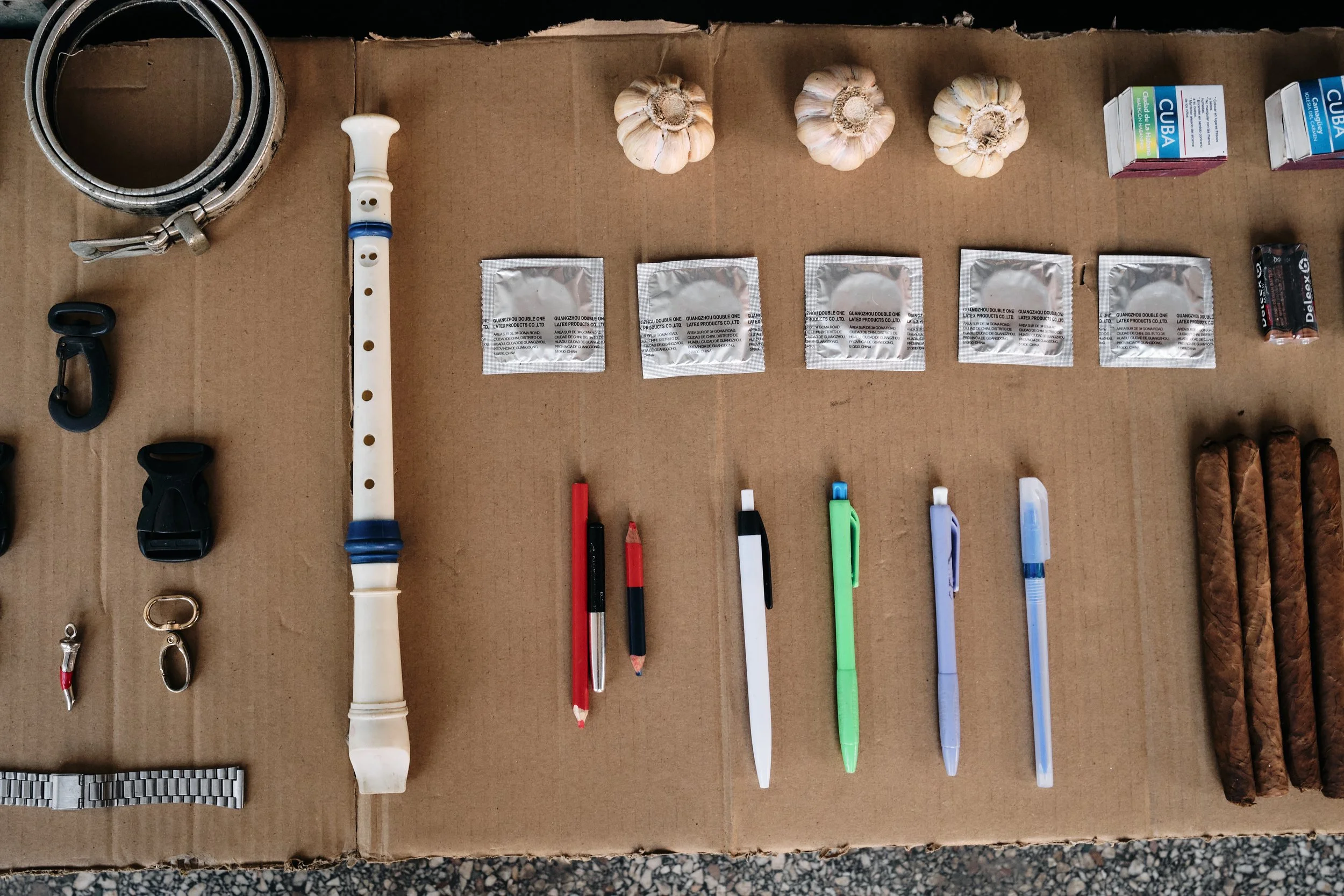
Photo Credit: Natalia Favre
Together, these perspectives point to a reality where poverty is systemic—reshaping how households survive, how labor is organized, and how social protections function across the island.
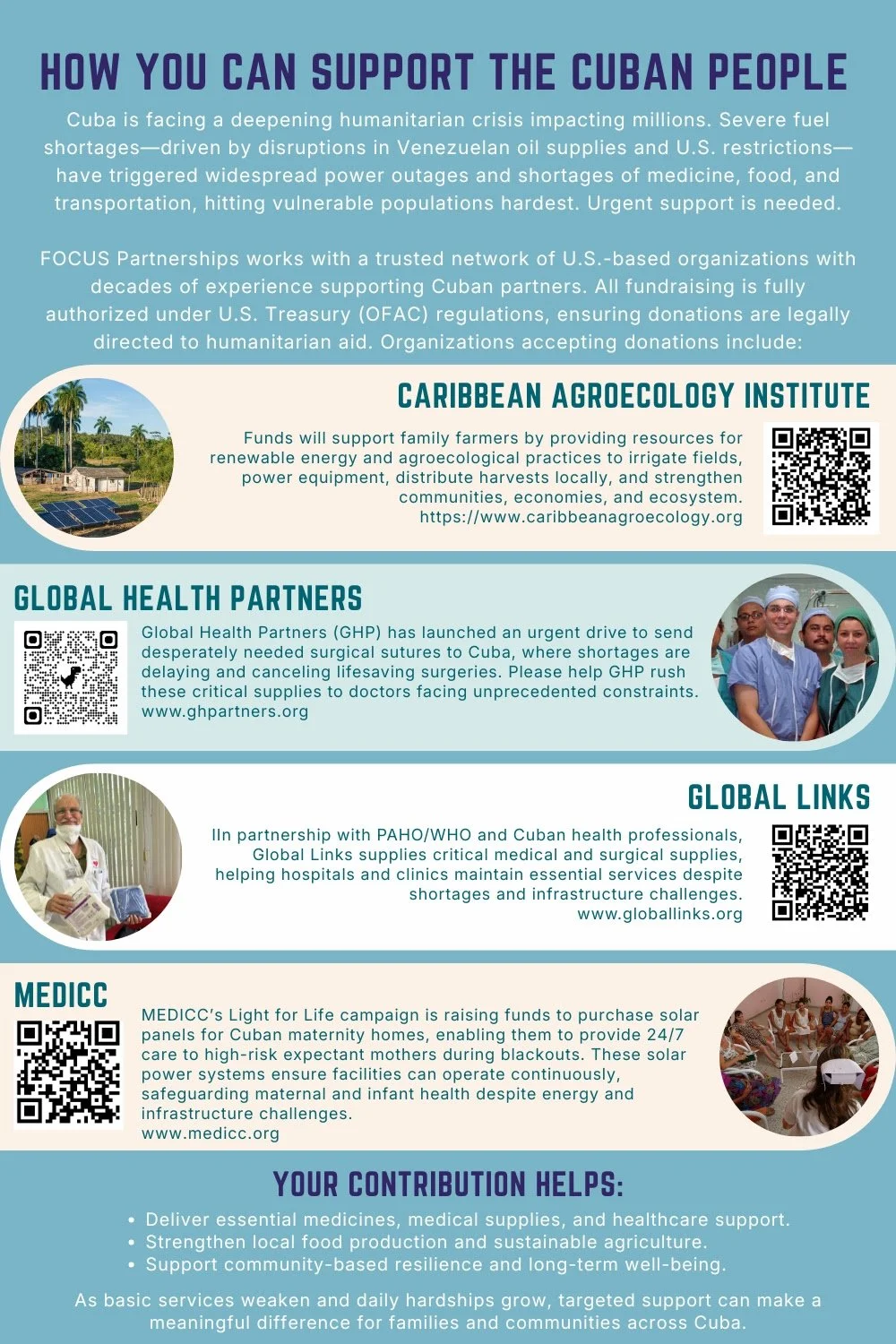
To support the Cuban people as daily life gets more challenging, please consider supporting the following organizations. This list has been curated by FOCUS, an initiative to strengthen collaboration between communities in Cuba and the US.
U.S.-CUBA NEWS
Preparation for U.S. Military Action on the Island
On April 14, initial reporting from Zeteo’s Substack, later confirmed by USA Today, alleged the White House had directed the Pentagon to begin preparations for possible military operations against Cuba. U.S. Southern Command declined to comment on the allegations and when asked about the reporting while on Air Force One, President Trump said: “Well it depends on what your definition of military action is.” This came as reporting showed a U.S. Navy drone flying down Cuba’s southern coast and circling Santiago de Cuba and Havana before returning to Florida. Now, for the first time in many decades, the prospect of U.S. military action in Cuba is real.
Cuba’s President Miguel Díaz-Canel responded to this reporting, vowing to defeat the US should an invasion occur stating, “As long as there is a woman and a man willing to give their lives for the revolution, we will be victorious,” during a speech on the 65th anniversary of the Bay of Pigs invasion.
A recent Miami Herald poll of 800 Cubans and Cuban Americans showed that 79 percent would be in favor of some form of military intervention in Cuba. Cuban Americans for Cuba responded in a statement, noting the poll was not representative of all Cubans across the US and rejecting the premise that Cuban Americans are largely in favor of military action. Cuban National Assembly deputy Carlos Miguel Pérez Reyes also pushed back against the polling, calling it “tragically famous.”
Senior State Department Officials Traveled to Cuba
According to an Axios report, a delegation of senior State Department representatives traveled to Cuba on April 10 to secretly discuss a “diplomatic solution” to the worsening democratic and economic conditions on the island after increased pressure from the Trump administration. The participants in the talks remain unclear, though Raúl Guillermo Rodríguez Castro, the grandson of Raúl Castro, has been confirmed to have taken part. An official told Axios that the discussion informed Cuba’s government of the “small window” to pursue U.S.-backed reforms before circumstances worsen, including a two-week deadline to release high-profile political prisoners. This deadline has now passed. Additional requests include compensation of U.S. residents and corporations whose assets were confiscated after the 1959 revolution, and greater political freedom, paving the way to free and fair elections. The U.S. delegation offered to bring Starlink satellite services to the island, operated by Elon Musk’s SpaceX.
On April 13, Cuba’s government confirmed the meeting and a Cuban official confirmed that Cuba’s delegation included representatives at the level of deputy foreign minister. Many suspect that Deputy Foreign Minister Josefina Vidal Ferreiro, who has been involved in negotiations with the US in the past, was among them. The Cuban official denied that the U.S. delegation issued any threats or a deadline, as reported by several U.S. media outlets.
In an interview with the Associated Press, Cuban Ambassador to the UN Ernesto Soberón Guzmán asserted that the release of political prisoners is “not on the negotiating table”, citing the need to respect each country’s internal affairs and differing legal systems. He added that leaders are “preparing for all scenarios” should President Trump follow through on threats to intervene in Cuba.
US Sends Plane to Retrieve Child in Transgender Custody CaseOn April 20, a U.S. Department of Justice (DOJ) plane traveled to Cuba to return a 10-year-old child from Utah who is at the center of a contentious international custody dispute. Rose Inessa-Ethington, a transgender woman and the child’s biological father, is accused of taking the child to Cuba without the permission of the child’s biological mother, with whom Inessa-Ethington shares custody. Federal authorities also alleged concerns that the child had been transported to Cuba for gender-affirming surgery prior to puberty.
According to the DOJ, on March 28, Inessa-Ethington and her partner told the biological mother the group was traveling to Calgary, Canada, for a camping trip. The group crossed into Canada on March 29 but never arrived at their hotel or campground. Instead, they flew from Vancouver to Mexico City, and on April 1, took a flight from Mérida, Mexico, to Havana. The child was due back on April 3 per the custody agreement, which was not honored. In an affidavit filed in Utah federal court, the Federal Bureau of Investigation (FBI) confirmed that Inessa-Ethington withdrew $10,000 from her checking account before leaving and left a note mentioning the money and gender-affirming medical care for children. There was no mention of Cuba.
Notably, Cuba has banned gender-affirming surgeries for minors, performing them only for adult citizens through the public health system under strict medical supervision. On April 13, a Utah state court ordered the child’s immediate return and granted the biological mother exclusive custody. Cuban law enforcement located the group on April 16, and they were returned to the US four days later. Inessa-Ethington and her partner face one count each of international parental kidnapping and are set to be returned to Utah.
Senate Fails to Pass Cuba War Powers Resolution
On April 28, Senate Republicans blocked the Senate Joint Resolution 124, a War Powers Resolution, introduced in March by Senator Tim Kaine (VA). The resolution would have directed the removal of U.S. forces from hostilities within or against Cuba not authorized by Congress and required President Trump to end the U.S. energy blockade on Cuba. Republicans argued the measure was out of order because the US is not engaged in outright hostilities with Cuba, and their motion to dismiss succeeded 51-47. Senator John Fetterman (PA) was the only Democrat to vote to dismiss the resolution, while Senators Susan Collins (ME) and Rand Paul (KY) were the only Republicans to support it.
Sen. Kaine pushed back on Republicans’ reasoning, arguing that the Trump administration’s oil blockade already constitutes hostilities given its devastating impact on Cuban civilians. On April 21, Representatives Pramilla Jayapal (WA-7) and Jonathan Jackson (IL-01) urged colleagues during a closed-door meeting of the Congressional Progressive Caucus to apply more pressure on the issue.
On April 16, Representative María Elvira Salazar (FL-27) chaired a House Foreign Affairs Western Hemisphere hearing examining next steps for Cuba and the broader region following the fall of Nicolás Maduro. Separately, Representatives demanded answers from the State Department after a Reps. Jackson and Jayapal were denied a meeting with Mike Hammer, the Chief of Mission of the U.S. Embassy in Havana, during their April congressional delegation to Cuba. Democratic members cited concerns over a departure from longstanding norms of cooperation between the legislative and executive branches.
Cuban ICE Detentions Climb While Green Card Approvals Decline
According to new polling from the CATO Institute, a libertarian think tank, green card approvals for Cubans have dropped drastically since President Trump took office. The Miami Herald notes that in October 2024, over 10,000 Cubans were approved for green cards, and by the end of 2025, they had dropped to just dozens, representing a 99.8 percent decline since December 2024. Over the same period, ICE arrests of Cubans rose 463 percent. A recent Miami Herald poll showed that 68 percent of Cubans disapprove of the Trump administration’s increased deportations of undocumented Cubans without criminal records.
In 2026, this decline can in large part be attributed to the memo issued by U.S. Citizenship and Immigration Services (USCIS) on December 2 that paused immigration cases from 19 countries, including Cuba. This has particularly disadvantaged Cubans, as they can adjust their status to lawful permanent resident after one year in the US due to the Cuban Adjustment Act.
Cuban National Dies in ICE Custody
On April 12, 27-year-old Cuban national Aled Damien Carbonell-Betancourt was found unresponsive in his cell at a Federal Detention Center in Miami in what appeared to be a “suicide attempt.” According to the official Immigration and Customs Enforcement (ICE) statement on April 16, detention center staff immediately initiated CPR, and the Miami Fire Rescue continued resuscitation efforts upon arrival. Despite life-saving measures, Carbonell-Betancourt was pronounced dead at approximately 7:31 a.m. The official cause of death remains under investigation.
Carbonell-Betancourt had entered the US on October 30, 2024, without valid documentation, was released on parole with a notice to appear, but was eventually taken into ICE custody in February 2026, pending removal proceedings. His death marks the 17th under federal detention in 2026, the ninth in ICE’s Miami Field Office, and the 48th since President Trump returned to office in January 2025. This is despite ICE statements confirming that detainees receive medical, dental, and mental health screenings upon arrival, along with access to ongoing care and 24-hour emergency services. Scholars calculate the number of deaths in ICE detention to be one every 5.9 days.
New Report Shows U.S. Exports to Cuba on the Rise
Despite rising tensions between Cuba and the US, a robust and largely “invisible” economic relationship has taken shape, driven not by formal agreements but by the Cuban private sector and the diaspora. A new report from Havana-based independent consulting firm AUGE found that between 2021 and 2025, U.S. exports to Cuba grew by 148 percent, rising to $810.8 million at the end of 2025, even as Cuba’s overall imports have declined. This increase demonstrates the growth of the private sector in Cuba. Interestingly, AUGE finds that when Cuba’s total imports fall, US exports rise.
Much of this trade operates outside official statistics through informal or semi-formal channels, including re-exports via third countries, remittances, and private shipping networks. South Florida, especially Miami, serves as the logistical and financial hub, with remittance agencies and shipping companies facilitating a steady flow of goods and capital to the island. Digital platforms, remote work, and diaspora investment further deepen this connection, allowing Cubans to participate in cross-border economic activity without physically migrating.
IN CUBA
Cuba’s Energy Crisis Harms Farmers
With limited fuel supplies, Cuba’s energy shock has triggered widespread blackouts, fuel rationing, and severe strain on basic services, including water, health, and food systems. The crisis has hit Cuba’s agricultural sector particularly hard. René Orellana, the Food and Agriculture Organization’s (FAO) regional representative for Latin America and the Caribbean, warned that fuel shortages are limiting farmers’ use of machinery for harvesting and that several crops are at risk of not being harvested properly, leaving the population unable to access those foods.
On the ground, farmers have abandoned machinery in favor of animal and manual labor. In Las Minas, 65 farmers share only 18 oxen, and many report receiving no government gasoline supply since January. In Artemisa, once known as Havana’s granary and responsible for roughly 40 percent of the capital’s fresh produce, cuts to the state procurement system have left crops to rot in the fields. Food prices are surging, the quality and quantity of produce is diminishing, and hunger is deepening across the island. The conditions have pushed some toward illegal trading or migration as individuals struggled to survive. As farmworker Jordanis Rios put it, “My goal is to survive here and see what happens.”
Iberia Suspends Flights to Cuba Until October
Cuba’s tourism sector is experiencing one of its worst downturns on record, with Cuba receiving a total of 298,057 international visitors in the first three months of 2026, 48 percent fewer than the same period last year. On April 13, Spain’s largest airline, Iberia, announced the temporary suspension of direct flights to Cuba starting in June, citing a significant drop in demand. The airline is gradually scaling back operations. Throughout April, Iberia has operated three weekly flights between Madrid and Havana, and will reduce to two weekly flights in May before suspending direct operations entirely in June. The airline intends to resume the route in November, provided conditions allow, and flight sales remain open from the month onward. In the meantime, customers will be rerouted to Panama, where they can take a Copa Airlines flight to Cuba.
Iberia’s operations had been disrupted since February 9, when aviation authorities warned that nine of Cuba’s main airports had exhausted their aviation fuel resources. Canadian airline Sunwing Vacations Group, which includes WestJet Vacations and Vacances WestJet Quebec, also canceled Cuba operations from June 20 through October 9.
CUBA’S FOREIGN RELATIONS
Mexico, Brazil, and Spain Issue Statement in Support of Cuba
On April 18, the governments of Brazil, Mexico, and Spain issued a joint statement expressing deep concern over the humanitarian crisis facing the Cuban people, calling for measures to alleviate the situation and sincere dialogue in line with international law. The statement, issued without explicitly listing the US, called for a lasting solution that allows the Cuban people to decide their own future. It coincided with the Summit in Defense of Democracy held in Barcelona, where Spain’s Prime Minister Pedro Sánchez hosted Brazil’s President Luiz Inácio Lula da Silva and Mexico’s President Claudia Sheinbaum. Notably, President Sheinbaum, who has maintained a restrained approach with the Trump administration, has taken a harder line in recent weeks amid increased tension over the deaths of Mexican citizens in U.S. immigration custody and the oil blockade on Cuba.
The statement reflects a broader effort by Brazil, Mexico, and Spain to maintain and strengthen their relationship with Cuba amid mounting external pressure on the island. President Sheinbaum has said that Mexico’s government is exploring new investment opportunities and trade agreements with Cuba. While she reluctantly paused oil shipments to Cuba, she has also asserted that Mexico has every right to provide oil to Cuba for humanitarian or commercial reasons.
Separately, on April 22, Brazil’s Minister of Education Leonardo Barchini met with Cuba’s Minister of Higher Education Walter Balujar García in Brasília to address joint initiatives in higher education, academic mobility, research, and educational public policy, further demonstrating Brazil’s efforts to maintain relations with Cuba. The three countries have also vowed to coordinate aid to the island; further details on the expected date and content of the aid have yet to be provided.
Cuba to Allow Russian Companies to Manage Production at State-Run Facilities
According to Russian Deputy Industry Minister Roman Chekushov, Russian firms will be granted access to oversee production in industrial sectors of Cuban state-owned entities, including metallurgy and energy-linked industries, as part of broader bilateral cooperation. Plans include reviving stalled projects like vehicle assembly and expanding output at facilities such as the Antillana de Acero steel plant, which could produce up to 160,000 tons annually once operational issues, particularly Cuba’s energy shortages are resolved. The initiative is tied to ongoing Russian financial support and oil shipments, framed by officials as part of a strategic and symbolic commitment to Cuba amid U.S. pressure. The move signals a shift toward deeper Russian influence in managing and sustaining Cuba’s struggling industrial economy.
Cuba To Release Three Panamanians After Accusations of Anti-Government Propaganda
In late February 2026, Cuban authorities arrested ten Panamanian citizens in Havana, accusing them of producing and displaying “subversive” anti-government propaganda. The debacle resulted in a visit from Panama’s Minister of Foreign Affairs on March 24 who hoped to secure their extradition. In late April, Cuba agreed to release three of the ten detainees, a gesture for which Panama thanked Cuba and President Díaz-Canel. Panama has framed the releases as a positive step but remains concerned about due process and the detainees’ well-being, while Cuba maintains that the arrests are justified under its laws.
New Report on Cubans Supporting Russia in War Against Ukraine
A new report from the International Federation for Human Rights, Truth Hounds, and the Kazakhstan International Bureau for Human Rights and Rule of Law (KIBHR), found that Cuba and Colombia are the most popular places in the region for Russia to recruit fighters. Russia’s foreign recruitment has been growing, with over 18,000 soldiers being recorded as foreigners. The report found that up to 20 percent of these fighters do not survive the first months of deployment. This is not a new phenomenon, as Russia has been recruiting Cubans since the war with Ukraine began. Often, individuals are approached by intermediaries promising well-paid jobs that turn out to be scams.
In October 2025, the State Department used the presence of Cuban fighters as part of its rationale to convince countries to vote against a UN resolution opposing the U.S. embargo on Cuba. Ukrainian officials told Congress in September 2025 that an additional 20,000 Cubans were “awaiting travel and deployment” to Russia. Cuba’s government has denied involvement in the war between Kyiv and Moscow, only acknowledging the existence of Cubans participating in the conflict "on their own."
Note on our previous brief regarding the number of political prisoners in Cuba
In our April 10 blast, we wrote: “At least 775 political prisoners remain behind bars, according to Justicia 11J, a human rights organization tracking political prisoners in Cuba. Another organization, Prisoners Defenders, puts the number much higher at 1,214 political prisoners.”
CEDA would like to clarify that the discrepancy between these figures stems from differing definitions of “political prisoner” used by each organization. Justicia 11J reports 775 individuals currently detained, reflecting its focus on those actively behind bars. In contrast, Prisoners Defenders reports a broader total of 1,214 cases, which includes 736 prisoners of conscience, 443 individuals convicted under conscience-related charges, and 35 additional cases classified as other political prisoners.
For more insights and information on political prisoners in Cuba:
Read this recent op-ed by Luis Manuel Otero Alcántara, co-founder of the San Isidro Movement and a current political prisoner in Cuba who was arrested during the July 11, 2021 protests
Read this El País story on two of the most well-known political prisoners in Cuba Maykel Osorbo and Luis Manuel Otero
Recommended Reading, Listening & Viewing:
Read | Bloomberg: Cubans in Crisis Have Fewer Ways to Leave After Trump Tightens Screws
Read | WSJ: Cuba Tried to Deliver Secret Letter Directly to Trump Via Businessman
Read | The Observer: All eyes on Raúlito, the Castro who could open Cuba’s doors to Trump
Read | Bloomberg: How to Rebuild Cuba’s Crumbling Economy
Read | Cayman Compass: Five days at sea: A Cuban refugee's harrowing journey to Cayman
Read | Cuba Capacity Building Project: Cuba’s Energy Crisis: Structural Roots and a Comparative Perspective
Read | The Guardian: Cubans self-medicate as crisis takes toll on mental health: ‘There is no idea to hold on to’
Read | Project Syndicate: Cuba in Free Fall by Pavel Vidal
Read | Nueva Sociedad: Cuba «resiste» con un modelo agotado
Read | The Nation: Lessons of the Bay of Pigs
Read | The Atlantic: Cubans' Despair
Watch | CNN: ‘What President Trump wants is to win’: Former negotiator on US-Cuba tensions
Read | Responsible Statecraft: In Cuba a deadlock is more likely than a deal
Read | El País: Alina Fernández, daughter of Fidel Castro: ‘People in Cuba need to breathe, to enter the 21st century, to give their children a life’
Read | Bloomberg: Chinese Hackers Spied On Cuban Embassy As US Prepared Blockade
Read | TIME:
Cuba Is Not a Prize. It Is a Warning.
Read | The Guardian: Cuba is running out of time. We need fuel now to save lives
Read | NYT: Will Communist Cuba Ever Pay Back the Billions It Confiscated?
Read | LA Times: ICE deported him to Mexico despite a federal court order not to. Now, they can't get him back
